
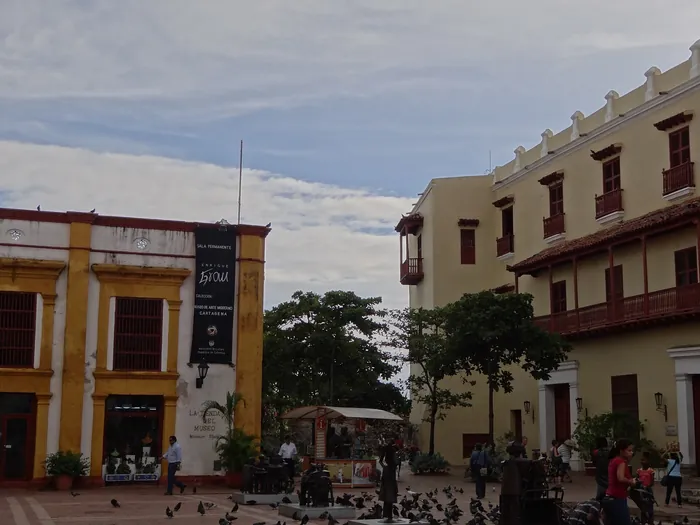
This route fits into one afternoon and three squares in the Centro: Plaza de Bolívar, Plaza de Santo Domingo and Plaza de San Pedro Claver. A museum of pre-Hispanic goldwork, a Dominican cloister turned cultural centre and a modern art museum set in an old warehouse by the city wall. About three hours on foot, at an easy pace.
Before you go, check the calendar. Monday is out: the Museo del Oro Zenú closes on Mondays, public holidays included, and so does the Museo de Arte Moderno, according to their official pages. Sunday does not work for this order either, because the Museo del Oro closes at 2:00 p.m. that day. From Tuesday to Saturday, leaving Plaza de Bolívar around two or three in the afternoon gives you time for all three stops. Carry water and walk in the shade of the balconies: at that hour the Centro sun is heavy.
First stop: gold and water
The Museo del Oro Zenú faces Plaza de Bolívar, in a house that dates from the 17th century, according to an El Universal column on its reopening. It opened as a museum on 27 March 1982 with nearly 700 pieces, 538 of them goldwork, according to the Banco de la República. The bank fully restored the building and reopened it on 18 February 2023 to launch its centenary celebrations. The works recovered a cistern that is now part of the visit.
Inside are gold and tumbaga objects, ceramics and shell made by peoples of the Cartagena bay, the lower Magdalena, the Caribbean savannas and the Serranía de San Jacinto. The display tells their story alongside the landscape: people who lived between water and land. There is a room devoted to women, present-day Zenú weaving, traditional jewellery from Mompox and Ciénaga de Oro, and bird-shaped ocarinas and fish-shaped flutes that the bank restored so they could be played again.
Admission is free, according to Banrep Cultural's visitor page. The same page lists free guided tours with no booking: in the afternoon there is one in Spanish at 3:00 and another at 4:00, and one in English at 3:00. It also warns that guides offering their services at the door do not work for the museum. Hours and tours can change, so it is worth confirming them. An hour is enough to walk in without a plan, which is the point of this stop.
Second stop: a cloister with a programme
From Plaza de Bolívar, follow the streets of the Centro to Plaza de Santo Domingo. There, at Carrera 36 No. 2-74, the Centro de Formación de la Cooperación Española occupies the cloister of the former Dominican convent. The Iglesia de Santo Domingo, on the same block, was designed and begun in the 16th century and is a declared national Bien de Interés Cultural, according to a study by architect Juan Luis Isaza published in the Universidad Javeriana journal Apuntes.
According to the centre's website, the CFCE was created in 1993 and has occupied the cloister since 2004, after a restoration by AECID: 7,700 square metres in all. The programme changes every month. In November 2026 its website announced «Transformar la mirada», a photography exhibition on Afro-descendant women, and the centre is one of the venues of the International Human Rights Film Festival. A December 2025 El Universal column lists what it usually offers: a public library, an exhibition hall and a courtyard with free film, dance and theatre.
There is one thing worth knowing. That column and The Diplomat in Spain, in February 2026, reported that the Archdiocese of Cartagena will not renew the loan agreement under which Spanish Cooperation uses the convent, and that the Spanish government is looking at other locations. No departure date has been made public. Before you go, check the agenda on the centre's website: it tells you what is on and whether the doors are still open. Allow half an hour to an hour, depending on the programme.
Third stop: the corner of Grau and Obregón
The last stop is on Plaza de San Pedro Claver, with the Baluarte de San Ignacio beside it. This is the Museo de Arte Moderno de Cartagena, which bears Enrique Grau's name. According to El Universal, Grau founded it with Alejandro Obregón as his accomplice, and its first director was Miguel Sebastián Guerrero. It is housed in the former Almacén de Galeras, a building the museum holds on loan from the Ministry of Culture. In 2026, the Institución Universitaria Mayor de Cartagena was carrying out the studies to have it declared a Bien de Interés Cultural.
In 2021, El Universal counted 475 works in the permanent collection, by artists from 18 countries, most made between the 1950s and the end of the 20th century. There is art from Cartagena, from Colombia and from Latin America, and the collection keeps growing through donations.
According to mamcartagena.org, it opens Tuesday to Friday from 11:00 a.m. to 6:00 p.m., and on Saturdays and Sundays until 5:00 p.m. It is the only one of the three stops that charges admission, with a national rate for visitors who show Colombian ID or a valid student card. Confirm hours and rates before you go. Allow an hour and arrive well before closing.
- 1
The museum
Go in without a plan.
- 2
The cloister
See what is on.
- 3
The corner
Finish at the former Almacén de Galeras.
The best time to go
Tuesday to Saturday, setting off from Plaza de Bolívar around 2 or 3 pm. On Sunday the Gold Museum closes at 2 pm, and on Monday both museums are closed.
What to bring
Water, and Colombian ID or a student card if you qualify for the Modern Art Museum’s national fare.
How long to spend at each stop
- The museum — around an hour
- The cloister — half an hour to an hour, depending on what is on
- The corner — around an hour
Where to stop and eat
Casa Salvaje is about a 3-minute walk from Plaza de Santo Domingo, between the second and third stops. Kanibal opens Monday to Saturday from noon, and SLVJ serves dinner from 7 pm: a good finish once the modern art museum has closed.
Shade and water
All three stops are indoors, so the sun only bites on the walk between squares. Keep to the shade of the balconies and carry water: the Centro heats up in the afternoon.
At night
This is not a night route: the Gold Museum closes at 5 pm and the Modern Art Museum at 6 pm on weekdays. Afterwards, the night carries on a few blocks away.
Accessibility
The streets between the three squares are cobbled and should be walked with care. The Gold Museum spreads its exhibition over several floors; if you need a lift, ask at the entrance.
Frequently asked questions
How much is the Zenú Gold Museum?
Nothing. Admission is free, according to Banrep Cultural.
Are there guided tours?
Yes, free and with no booking at the Gold Museum. In the afternoon there is one in Spanish at 3 and another at 4, and one in English at 3.
Which of the three stops charges?
Only the Museum of Modern Art: COP 25,000 full adult fare and COP 20,000 national fare, according to its website.
Nearby
- Movich Hotel Cartagena de Indias · 1 min walk
- El Barón · 1 min walk
- Palacio de la Inquisición – Museo Histórico de Cartagena · 2 min walk
- Sala de Despecho Cartagena · 2 min walk
Foto: Kamilokardona / Wikimedia Commons (CC BY-SA 3.0)
Sources · 16
- Banrep: Museo del Oro Cartagena ↗
- CFCE agenda ↗
- Banrep Cultural: planee su visita al Museo del Oro en Cartagena (horario, entrada, visitas guiadas) ↗
- Banrep: apertura Museo del Oro Zenú 2023 ↗
- El Universal: MOZ, 6.000 años de historia (feb. 2023) ↗
- Revista Apuntes (Javeriana): Dos iglesias cartageneras del siglo XVI ↗
- cfcartagena.aecid.es (historia del centro, programación) ↗
- El Universal: Sobre duelos y dolientes (dic. 2025) ↗
- The Diplomat in Spain: la Cooperación Española pierde su sede en el convento de Santo Domingo (feb. 2026) ↗
- El Universal: buscan que el MAMC sea patrimonio (ago. 2026) ↗
- El Universal: 5 razones para visitar el MAMC (sept. 2021) ↗
- El Universal: Yolanda Pupo cuenta la historia del MAMC (oct. 2024) ↗
- mamcartagena.org (ubicación, horario, tarifas) ↗
- Casa Salvaje: Kanibal (horario) ↗
- Casa Salvaje: SLVJ (horario) ↗
- Nomado Travel: murallas de Cartagena (acceso, sombra, accesibilidad, noche) ↗