
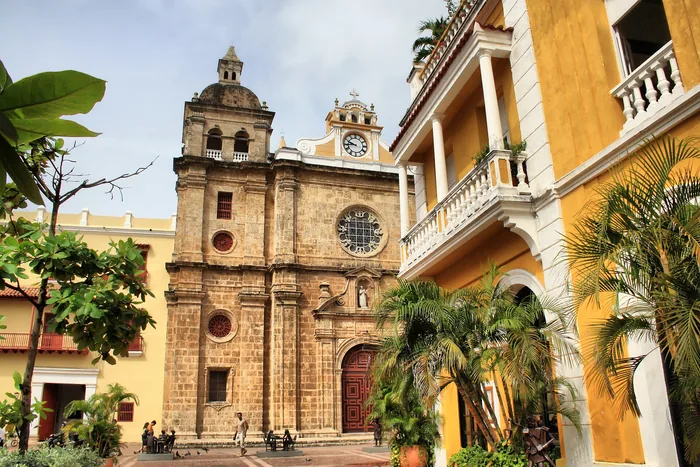
Four stops in the Centro, all a few blocks from one another, meant for an afternoon that begins at a table facing the Plaza de San Pedro Claver and ends on a rooftop on the Calle del Colegio. In between there is a museum with 17th-century vaults and the cloister of a former convent.
A table facing the plaza
The first stop is El Barón, at Carrera 4 #31-7, right on the Plaza de San Pedro Claver. It calls itself a "Cocktail Bar". By day it also works as a café, with a morning menu, and it has its own aperitivo hour. According to its website, table service runs Monday to Thursday from 4 p.m. and Friday, Saturday and Sunday from noon. Check before you go.
From the table the plaza makes sense. On one side stands the church of San Pedro Claver, which keeps in its high altar the remains of the Jesuit who devoted his life to the enslaved Africans arriving at the port, and which was declared a national monument in 1995. In the plaza there are two conversations in metal. One is "El Santo y el Esclavo", by Enrique Grau, showing the meeting between Claver and an enslaved African; according to El Universal, it was the last work Grau donated to the city, and in September 2026 it was found splashed with blue paint. The other is "Cotidianidad", by Edgardo Carmona: a cart pusher, a seamstress, a barber and two friends over a chessboard, in aged steel, standing there since 1999.
Vaults for masts, rooms for art
Across the plaza is the Museo de Arte Moderno de Cartagena, which bears Enrique Grau's name. According to the museum itself, the building is a brick-and-mortar warehouse from the second half of the 17th century, where masts, sails and other ship's stores were kept. Its vaults rise more than twelve meters and sit right against the Baluarte de San Ignacio. In the late 19th century another warehouse was added, from the republican era, which the Banco de la República used to store sacks of salt. Today it holds temporary exhibitions.
Its collection began to take shape in the late 1950s, with José Gómez Sicre, arts director of the OAS, acting as mediator. In 1972 Grau and Alejandro Obregón reorganized the museum; in 1977 it moved from the Salón Vicente Martínez to the colonial warehouse and opened there in December 1979. The permanent collection numbers 475 works by artists from 18 countries, according to El Universal. In August 2026 the museum and the Institución Universitaria Mayor de Cartagena signed an agreement to seek a Bien de Interés Cultural (heritage) declaration for the building.
Mind the hours. According to its website, it opens Tuesday to Friday from 11 a.m. to 6 p.m., and Saturday and Sunday until 5. It is closed on Mondays. It is one of the few covered public spaces in the walled city, something you appreciate in mid-afternoon.
The cloister of Santo Domingo
From there, walk toward the Plaza de Santo Domingo. On the way, look for the shade of the balconies and carry water: at that hour the Centro's sun weighs on you. On the plaza stands the church of Santo Domingo, built around 1580; El Tiempo explains that the callejón de los Estribos takes its name from the buttresses that hold up the weight of the church, which back then were called estribos. The "Gorda Gertrudis", by Fernando Botero, is here too.
Next door is the former convent of Santo Domingo, from the 16th century. Since 2004 its restored cloister has been home to the Centro de Formación de la Cooperación Española, which runs an open cultural program: exhibitions, workshops, film and festivals. In September 2017 Pope Francis was there during his visit to Colombia. One important note: in February 2026, The Diplomat in Spain reported that the Archdiocese of Cartagena will not renew the loan agreement for the building and that the Spanish government is weighing another home for the center. The site does not publish visiting hours. The best plan is to check the agenda at cfcartagena.aecid.es and come for an activity.
Ending from above
The last stop is Alquímico, at Calle del Colegio #34-24. It is a three-story house and each floor has its own menu: the first is called Comunidad, the second Clásicos Alquimistas and the third Farm to Bar. Up top is the rooftop, with plants and its own bar; from there you see the rooftops of the old city, not the sea. According to Revista Mercado, Alquímico placed third on The World's 50 Best Bars 2026 list, after ranking 11th in 2025, and it works with growers and with its own farm in Quindío.
It does not take reservations: entry is first come, first served. It opens every evening, but its website shows two different times, 6 and 7 p.m., so confirm before you go. The practical plan is to start at El Barón at noon on a Friday, Saturday or Sunday, leave the museum for early afternoon, stop at Santo Domingo as the sun drops and climb to the rooftop once night has fallen. On weekdays, with El Barón opening at 4, the museum is left with little time.
- 1
A first table
Start unhurried, facing the plaza.
- 2
The gallery
Follow your curiosity from room to room, on the same plaza.
- 3
The cloister
A pause in the shade of the former convent of Santo Domingo.
- 4
From above
Finish with another perspective, on a rooftop.
The best time to go
Friday to Sunday, starting at noon: on those days El Barón opens at 12. Monday does not work, because the museum is closed.
What to bring
Water, light clothes and comfortable shoes for the cobblestones.
How long to spend at each stop
- A first table — about 45 min
- The gallery — around an hour
- The cloister — 30 to 45 min, depending on the programme
- From above — as long as the night asks
Where to stop and eat
El Barón is the first table on the route. Before heading up to the rooftop, Casa Salvaje is about a 3-minute walk from Plaza de Santo Domingo: Kanibal opens Monday to Saturday from noon, and SLVJ serves dinner from 7 pm, the hour Alquímico opens.
Shade and water
The Museum of Modern Art is one of the few covered public spaces in the walled city, welcome in mid-afternoon. Between stops, keep to the shade of the balconies and carry water.
At night
The route is meant to end at night, on the rooftop of Alquímico, which opens every day from 7 pm. The Centro usually has police presence in busy areas; stay on streets with people and head back by taxi or app.
Accessibility
The Centro’s streets are cobbled: at street level they can be walked with care. Alquímico’s rooftop is on the third floor of an old house; if you cannot climb stairs, ask first.
Frequently asked questions
Do I need to book at Alquímico?
No. Alquímico does not take reservations: it is first come, first served.
How much is the Museum of Modern Art?
According to its website, the full adult fare is COP 25,000 and the national fare COP 20,000, with Colombian ID.
Can I do it on a Monday?
Better not: the Museum of Modern Art is closed on Mondays.
Does the Santo Domingo cloister have visiting hours?
It does not publish any. Check the programme of the Spanish Cooperation Training Centre and go to an activity.
Nearby
- Santuario de San Pedro Claver · 1 min walk
- Sala de Despecho Cartagena · 1 min walk
- Museo de Arte Moderno de Cartagena · 1 min walk
- Museo del Oro Zenú · 1 min walk
Foto: Martinduquea / Wikimedia Commons (CC BY-SA 3.0)
Sources · 23
- Alquímico: horario ↗
- OpenTable: El Barón ↗
- elbaron.co (dirección, horario, concepto) ↗
- Wikipedia: Iglesia de San Pedro Claver (apoyo) ↗
- El Universal: vandalizan escultura de Enrique Grau (sep. 2026) ↗
- El Universal: «Cotidianidad» de Edgardo Carmona (2017) ↗
- mamcartagena.org (horario, espacio cubierto) ↗
- mamcartagena.org: historia ↗
- mamcartagena.org: arquitectura ↗
- El Universal: 5 razones para visitar el MAMC (colección) ↗
- El Universal: declaratoria del edificio del MAMC (ago. 2026) ↗
- El Tiempo: origen de los nombres de las calles de Cartagena ↗
- El Universal: la Gorda Gertrudis en la Plaza Santo Domingo ↗
- cfcartagena.aecid.es (sede desde 2004, programación) ↗
- Minuto30: el papa en el claustro de Santo Domingo (2017) ↗
- The Diplomat in Spain: fin del comodato del convento (feb. 2026) ↗
- alquimico.com (pisos, sin reservas, horario) ↗
- Revista Mercado: 50 Best Bars 2026 ↗
- Sandbeds: azotea de Alquímico ↗
- Casa Salvaje: Kanibal (horario) ↗
- Casa Salvaje: SLVJ (horario) ↗
- Nomado Travel: murallas de Cartagena (acceso, sombra, accesibilidad, noche) ↗
- Semana: ¿qué tan seguro es el Centro de Cartagena para los turistas? (jul. 2024) ↗