
Routes / 06
The plazas of the Centro.
A walk to understand the Centro through its open spaces, from the Torre del Reloj to San Diego.
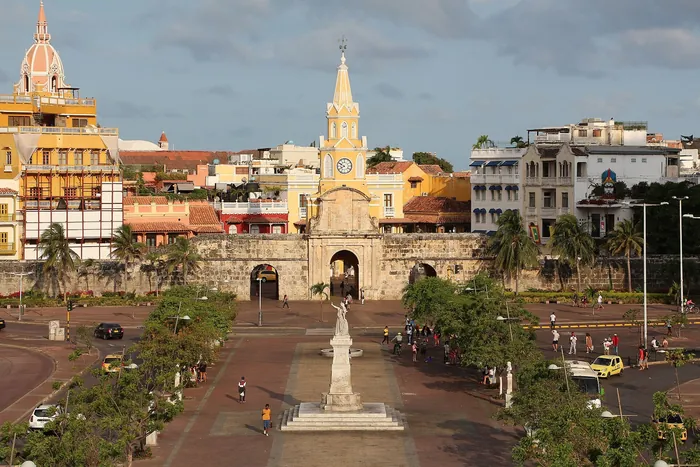
The walled city makes more sense through its open spaces than through its facades. The plazas were port, market, convent forecourt and stage for festivities, and they still set the rhythm of life in the Centro. This route links six of them, from the Torre del Reloj to San Diego, in about two hours at an easy pace. It is best to set out early, before the sun heats the stone, or late in the afternoon, when the plazas fill up. Bring water and a hat: the distances are short, but the heat wears you down.
Through the main gate
You enter through the Torre del Reloj. According to El Universal, in 1601 this spot was a drawbridge over the caño de San Anastasio, linking Getsemaní with the city, and from 1631, once the walls were finished, it was the main gate of Cartagena. The first clock, brought from the United States, was installed in 1874 and decades later replaced by a Swiss one. The tower you see today dates from 1888: architect Luis Felipe Jaspe Franco changed its square plan to an octagonal one, with a Gothic air and a height of about 30 metres.
Once through, the Plaza de los Coches appears, a triangle framed by two- to five-storey mansions with wooden balconies. In the middle stands the statue of Pedro de Heredia, the city's founder, which became a subject of debate during the 2021 national strike protests. Under the arcades is the Portal de los Dulces, with cocadas, melcochas and muñequitas de leche. According to a study by architect Juan Luis Isaza in the journal Apuntes, from the Universidad Javeriana, the Dominicans' first convent stood on the old Plazuela de la Yerba, today the Plaza de los Coches; after the fire of 1552 it moved to the site it occupies today.
Port, customs and sculpture
A few steps on opens the Plaza de la Aduana, which El Universal considers the largest in Cartagena. It was the port's plaza. An article in the journal Portus notes that in 1571 it was called Plaza Real, that it originally faced the bay of Las Ánimas, and that it held the house of the Real Contratación and the old house of the Real Contaduría, or Customs House, now City Hall. The statue of Christopher Columbus has stood in the plaza since 1894.
Next comes the Plaza de San Pedro Claver, in front of the church of the Jesuit missionary who was called "slave of the slaves". His statue is the work of Enrique Grau. Around it are Edgardo Carmona's steel figures: a vendor with his cart, a seamstress, a barber, two friends playing chess. According to El Universal, they have been there since 1999, and the Ministry of Culture declared them heritage of the city in 2004. The Museo Santuario San Pedro Claver has operated in the Jesuit cloister since 1950. On the same plaza, in the old Almacén de Galeras, is the Museo de Arte Moderno, founded by Grau with the collaboration of Alejandro Obregón. According to its website, it opens Tuesday to Sunday from 11 a.m. and is closed on Mondays; check before you go.
Under Bolívar's trees
The Plaza de Bolívar is the route's break, with shade and benches. It was once the Plaza Mayor. The park was inaugurated on 29 May 1892, and that same night, El Universal recounts, Cartagena had electric light for the first time. Jaspe Franco designed the spot where the equestrian statue of the Liberator would stand. The most recent reinauguration, with the railings removed, was on 3 November 2023.
Around the plaza are the Palacio de la Inquisición, home of the Museo Histórico de Cartagena since 1940, and the Museo del Oro Zenú, which the Banco de la República opened in 1982 and reopened, restored, on 18 February 2023. It displays goldwork, ceramics and Zenú flutes restored so they can be played. According to El Universal, in 2025 admission was free and it opened Tuesday to Sunday; check the hours before you go.
Santo Domingo and the finish in San Diego
Along the calle de Santo Domingo, between jewellers and craft shops, you reach the plaza of the same name. The convent of Santo Domingo, founded in 1551, was the city's first. According to Isaza's study, work on the present church was announced in 1579, suffered during Francis Drake's attack in 1586, and the roof was only finished around 1630. The five buttresses added to hold up the side wall gave the Callejón de los Estribos its name. In the plaza lies Fernando Botero's Gertrudis. As evening falls it is one of the liveliest plazas.
The route ends at the Plaza de San Diego, a meeting point for students and artists. Across from it stands the former convent of San Diego. The Portuguese captain Jorge Fernández Gramajo, a slave trader, donated the land for the cloister in 1608 and paid for much of the work; his tombstone, from 1626 and the oldest found in the city, has been on display at the cloister entrance since 2017. The building was a convent until 1821, then a nautical school, a prison between 1833 and 1968 and a psychiatric hospital until 1976, according to El Universal. Today it houses Unibac, heir to the Escuela de Bellas Artes founded on 20 August 1889. It is a good place to finish: a bench, an egg empanada and the plaza filling up with the afternoon.
- 1
Plaza de los Coches
The way in through the Torre del Reloj and the Portal de los Dulces.
- 2
Plaza de la Aduana
A wide plaza beside the old Customs House, now City Hall, with the statue of Columbus.
- 3
Plaza de San Pedro Claver
The modern art museum and the metal sculptures.
- 4
Plaza de Bolívar
Shade, pigeons and the Museo del Oro Zenú.
- 5
Plaza de Santo Domingo
Open-air tables facing the church considered the oldest in the city.
- 6
Plaza de San Diego
Finish in front of the former convent of San Diego, now the Bellas Artes school.
The best time to go
Early, before the sun heats the stone, or late afternoon, when the squares fill up.
What to bring
Water, a hat and cash for a cocada at the Portal de los Dulces.
How long to spend at each stop
- Plaza de los Coches — about 15 min
- Plaza de la Aduana — about 10 min
- Plaza de San Pedro Claver — about 15 min, or an hour if you go into the museum
- Plaza de Bolívar — about 20 min, in the shade
- Plaza de Santo Domingo — about 15 min
- Plaza de San Diego — as long as the bench holds you
Where to stop and eat
Plaza de Santo Domingo, the fifth stop, is about a 2-minute walk from Casa Salvaje. If you set off early, lunch falls just right: Kanibal opens Monday to Saturday from noon and on Sunday from 11 am.
Shade and water
Plaza de Bolívar is the pause on the route, with trees and benches. Elsewhere the stone heats up: bring water and a hat.
At night
As the afternoon fades, Santo Domingo is one of the liveliest squares, and in San Diego the tables come out onto the square. Busy areas usually have police presence; at night, avoid empty streets.
Accessibility
The streets between the squares are cobbled and level: walk them with care.
Frequently asked questions
Do I have to pay anything?
The squares are public space. You only pay to enter a museum: the Modern Art Museum charges; the Zenú Gold Museum is free.
How long does it take?
About two hours at an easy pace, not counting museums.
Which day is best?
Tuesday to Sunday if you want to enter the museums: both close on Mondays.
Nearby
- Tu Candela · 1 min walk
- Eivissa Cartagena · 1 min walk
- Barra 7 · 1 min walk
- El Pasquín de Joaco · 1 min walk
Foto: Bernard Gagnon / Wikimedia Commons (CC BY-SA 4.0)
Sources · 24
- FICCI: Plaza de la Aduana ↗
- El Universal: tour Centro Histórico ↗
- Nomado Travel: Iglesia de Santo Domingo ↗
- FICCI: Unibac, Plaza de San Diego ↗
- El Universal: 135 años de Bellas Artes ↗
- OpenStreetMap/Nominatim (coordenadas de paradas, consultado 2026-11-07) ↗
- El Universal: la Boca del Puente, puerta principal ↗
- El Universal: debate por la estatua de Pedro de Heredia (2021) ↗
- Revista Apuntes (U. Javeriana): Dos iglesias cartageneras del siglo XVI, la Catedral y Santo Domingo ↗
- Portus: La plaza de la Mar, Cartagena de Indias ↗
- Colombia Travel: plaza de San Pedro Claver ↗
- El Universal: el óxido y las esculturas de la plaza San Pedro (2017) ↗
- El Universal: declaratoria Almacén de Galeras (ago. 2026) ↗
- mamcartagena.org (horario) ↗
- El Universal: el día que se inauguró el Parque de Bolívar ↗
- El Universal: lugares para visitar, horarios y tarifas 2025 ↗
- Banco de la República: sucursal Cartagena / Museo del Oro ↗
- Banrep: apertura Museo del Oro Zenú 2023 ↗
- El Universal: la historia que encierra la cárcel de San Diego ↗
- El Universal: secretos de una lápida de 1626 ↗
- Casa Salvaje: Kanibal (horario) ↗
- Banrep Cultural: planee su visita al Museo del Oro Zenú (horario, entrada, visitas guiadas) ↗
- Nomado Travel: murallas de Cartagena (acceso, sombra, accesibilidad, noche) ↗
- Semana: ¿qué tan seguro es el Centro de Cartagena para los turistas? (jul. 2024) ↗