
Routes / 04
The walls at sunset.
A walk from bastion to bastion, southwest to northeast, with the sea always on your left.
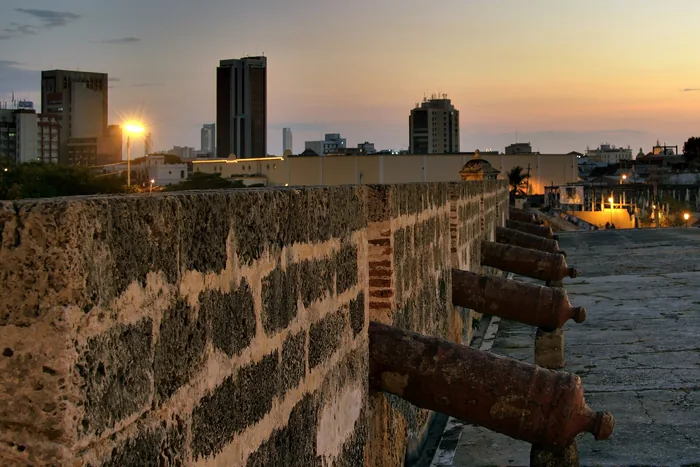
Cartagena's city wall makes most sense from the top. This walk goes from bastion to bastion along the stretch facing the sea, from Santo Domingo to Santa Catalina, then comes down through Las Bóvedas to the Plaza de San Diego. Six stops, an hour and a half at a stroll. The sea stays on your left the whole way and the Centro on your right.
Historian Rodolfo Segovia tells the short version in La República. In 1585 Philip II decided to fortify his American domains. The engineer Bautista Antonelli drew a plan for the island in 1595, which Segovia calls the walls' birth certificate. The definitive works began in 1614, at the Baluarte de Santo Domingo itself, and the ring was complete by 1635. The seafront stretch, the Muralla de la Marina, took the worst of it: storms knocked down whole bastions, and they had to be raised again and again.
Santo Domingo, where it all began
The Baluarte de Santo Domingo was the first of the city's great bastions. Antonelli and his nephew Cristóbal de Roda designed it around 1602. It is named after the Puerta de Santo Domingo, the gate next to it, though it was also called San Felipe and Santa María. In the early 18th century the engineer Juan de Herrera y Sotomayor remodelled it and added the large sentry box that crowns the point facing the sea.
For more than twenty years an open-air restaurant operated here. The Administrative Court of Bolívar ordered the space recovered in 2019, and the Council of State upheld the ruling in 2022. The city removed the tables in September 2024 and the kitchen and bar that November. Get there a little before sunset. According to timeanddate.com, the sun sets around 5:36 pm in November and between 6:20 and 6:27 pm in June.
La Merced and Santa Clara, against the waves
The Baluarte de la Merced is named after the convent of La Merced, which stood where the Teatro Adolfo Mejía is today. Cristóbal de Roda built it around 1617, and a norte, as storms are called here, destroyed it the following year. Governor and engineer Francisco de Murga finished rebuilding it in late 1629. Between 1721 and 1733 Herrera y Sotomayor gave it its present shape.
Next comes the Baluarte de Santa Clara, named after the Poor Clares convent behind it. According to the Sociedad de Mejoras Públicas, it defended the city against enemies arriving from the northern sea, shielded it from the waves and held 14 cannons. In 1761 Arévalo demolished part of the bastion and used the stretch linking it to Santa Catalina to build vaults.
The convent of Santa Clara was founded in 1621 on land donated by Catalina de Cabrera. Religious reforms closed it in 1861, and today it is a hotel. The hotel tells how, when its crypt was excavated, Gabriel García Márquez went along with the archaeologists, and how that visit became Of Love and Other Demons.
Santa Catalina, the windy corner
The Baluarte de Santa Catalina is the northeastern tip of the wall. According to Fortificaciones de Cartagena, Cristóbal de Roda finished it around 1625 and turned the Santa Catalina and San Lucas bastions toward La Boquilla. The Baron de Pointis's attack in 1697 forced a rebuild. In 1719 Herrera y Sotomayor moved the entrance next to San Lucas and began the breakwater.
In front is the jetty locals call La Tenaza. Arévalo built it in 1779 to protect the beach that had formed in front of the bastion after he himself raised the Muro de la Marina between 1765 and 1771. The wind hits harder here, with open sea on one side and the rooftops of San Diego on the other.
Down through Las Bóvedas to San Diego
The way down is through Las Bóvedas, built against the wall between Santa Catalina and Santa Clara. There are 23 of them. According to El Tiempo, Arévalo's proposal dates from 1773, work began in 1792, and a coat of arms on the central arch gives 1798 as the year they were finished. They were built to house the garrison and store food and supplies. During the civil wars of the 19th century they served as a jail. Since the 1970s they have been occupied mostly by craftspeople, and in 2024 the Escuela Taller Cartagena de Indias was working to recover them and award them again.
From there it is a few blocks to the Plaza de San Diego. The name comes from the convent of San Diego, which operated from 1608 to 1821. According to El Universal, the cloister then became a nautical school, a prison from 1833 to 1968 and a psychiatric hospital, until around 1976 it became Bellas Artes, today UNIBAC. A good place to finish.
A few tips. Bring water and comfortable shoes: even late in the afternoon the heat doesn't fully let up. The wall is public space. According to El Universal, a 2018 Ministry of Culture resolution forbids restricting public access in areas used by businesses. Ideally, be at Santo Domingo half an hour before sunset and continue the walk in the evening breeze.
- 1
Baluarte de Santo Domingo
A bastion open to the public again, for watching the sun go down over the sea.
- 2
Baluarte de la Merced
The wall continues north, with the Centro at your back.
- 3
Baluarte de Santa Clara
Behind the former convent of Santa Clara.
- 4
Baluarte de Santa Catalina
The northeastern tip of the wall: wind, open sea and the rooftops of San Diego.
- 5
Las Bóvedas
Come down from the wall among arches and craft stalls.
- 6
Plaza de San Diego
Finish at a table on the plaza.
The best time to go
Be at Santo Domingo half an hour before sunset. In November the sun sets around 5:36 pm; in June, between 6:20 and 6:27 pm.
What to bring
Water, comfortable shoes and something light for the wind at Santa Catalina.
How long to spend at each stop
- Baluarte de Santo Domingo — about 20 min, until the sun goes down
- Baluarte de la Merced — about 10 min
- Baluarte de Santa Clara — about 10 min
- Baluarte de Santa Catalina — about 15 min, wind in your face
- Las Bóvedas — about 15 min
- Plaza de San Diego — as long as the table lasts
Where to stop and eat
Casa Salvaje is about a 4-minute walk from the Santo Domingo Bastion, where the route begins: Kanibal opens from noon for a late lunch before you climb up. When you finish in San Diego, the house is about 13 minutes away on foot, and SLVJ serves dinner from 7 pm to midnight.
Shade and water
There is no shade up top: between 11 am and 3 pm the sun hits the wall full on. That is why the route is at sunset. Carry water, because the heat never fully lets up.
At night
The wall and the streets of the walled city are open at any hour, although some bastions may close at night. Between bastions there are poorly lit stretches: after dark, walk in company and stay where there are people.
Accessibility
The upper bastions are not wheelchair accessible, and the path along the top is broken by stairs in places. Below, the cobbled streets can be walked with care.
Frequently asked questions
Do I have to pay to walk on the wall?
No. Access is free and the wall is public space.
What time is sunset?
In November, around 5:36 pm; in June, between 6:20 and 6:27 pm, according to timeanddate.com.
Can I do it in a wheelchair?
Not along the top: the bastions have no wheelchair access and there are stairs. You can follow the wall along the streets below, with care.
Nearby
- La Vitrola · 3 min walk
- La Movida · 3 min walk
- NH Galería · 3 min walk
- Centro de Formación de la Cooperación Española · 3 min walk
Foto: Martin St-Amant (S23678) / Wikimedia Commons (CC BY-SA 3.0)
Sources · 19
- Tripadvisor: Baluarte de la Merced ↗
- Burgenwelt: fortificaciones de Cartagena (coordenadas) ↗
- Tripadvisor: Las Bóvedas ↗
- Wikipedia: Cuartel de Las Bóvedas ↗
- SMP Cartagena: Baluarte de Santa Clara ↗
- El Universal: Distrito recupera el Baluarte de Santo Domingo ↗
- OpenStreetMap/Nominatim (coordenadas de paradas, consultado 2026-11-07) ↗
- La República: Las murallas de Cartagena de Indias (Rodolfo Segovia) ↗
- Wikipedia: Bastion of Santo Domingo, Cartagena ↗
- timeanddate.com: salida y puesta del sol en Cartagena (noviembre) ↗
- Fortificaciones de Cartagena: Baluarte de La Merced ↗
- Historic Hotels: historia del Sofitel Legend Santa Clara ↗
- El Tiempo: plan de la Nación para recuperar fortificaciones (2024) ↗
- El Universal: La historia que encierra la cárcel de San Diego ↗
- El Universal: Baluartes de Cartagena, lo que debe saber sobre su uso (2021) ↗
- Nomado Travel: murallas de Cartagena (acceso, sombra, accesibilidad, noche) ↗
- Casa Salvaje: Kanibal (horario) ↗
- Casa Salvaje: SLVJ (horario) ↗
- Semana: ¿qué tan seguro es el Centro de Cartagena para los turistas? (jul. 2024) ↗