
Routes / 11
By sea to Bocachica.
Cross the bay by boat to the fort of San Fernando and stay on in the village of Bocachica, on the island of Tierra Bomba.
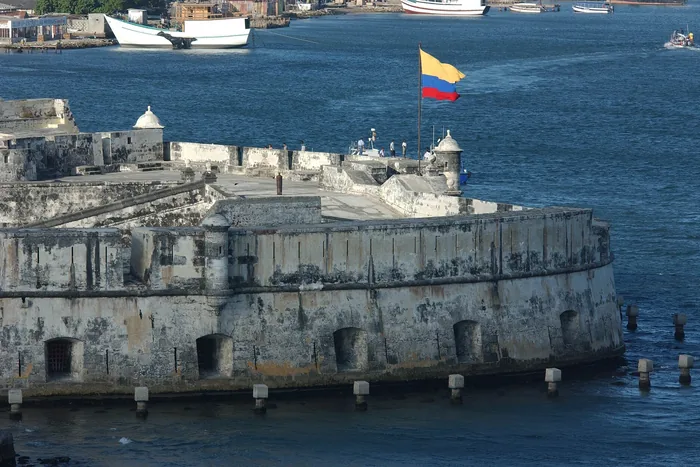
Bocachica is the name of a channel and of a village. The channel is the only way ships can enter Cartagena Bay, between the island of Tierra Bomba and Barú. The village sits at the southern tip of Tierra Bomba, belongs to the city district and lives in the shadow of the fortress that guards the passage: the fort of San Fernando. This route goes by sea, takes its time in the fort, looks across the water at the battery of San José and ends in the village and on its beach. El Universal suggests setting aside half a day or a whole day. In a hurry, it makes no sense.
The boat from La Bodeguita
Boats leave from the Muelle de La Bodeguita, on Avenida Blas de Lezo, opposite the Centro's city wall. According to El Universal, the trip to Bocachica takes 15 to 20 minutes. The Cartagena Explorer guide, written in 2019, also describes shared boats that leave very early, once they fill up, and make several stops before the fort. Fares and timetables change, so it is worth asking at the jetty before boarding and checking that there are life jackets for everyone.
The crossing is already part of the visit. The boat heads south across the bay, leaves the towers of Bocagrande and Castillogrande behind and skirts Tierra Bomba to its tip. There the water narrows and the two forts that closed the passage appear, facing each other.
San Fernando, the key to the channel
The fort stands right on the edge of the channel, horseshoe-shaped and facing the sea. According to the Fortificaciones de Cartagena website, run by the Escuela Taller, the engineer Antonio de Arévalo began work on 12 March 1753, after the English attack of 1741 had ruined the earlier defences. The first stage was finished in 1759, and the fort is named after King Ferdinand VI. It has two bastions facing land, the King's and the Queen's, nine bombproof vaults, a dry moat and underground galleries with countermines. In 1760 Arévalo added the Santiago and San Francisco Regis batteries. In the early 19th century it held some leaders of the independence movement as prisoners.
Since 2024, several of those vaults have housed the Museo de Oficios, a museum of trades created by the Escuela Taller Cartagena de Indias and ICANH together with the Bocachica community. Its rooms, according to El Universal, show artisanal fishing, local cooking, traditional hairstyles, canoe building, the work of midwives, music and dance, and local people act as guides. In April 2026 the same newspaper reported that the museum opens Monday to Sunday, 8:00 a.m. to 5:00 p.m., with free entry. Check before you go.
San José, the partner on the other side
From the fort's jetty you can see the battery of San José across the channel. The two works operated together: no ship could enter without passing under their guns. According to Fortificaciones de Cartagena, today's battery rebuilds and reinforces the one Juan de Herrera built between 1714 and 1725, which Vernon destroyed in 1741. Arévalo completed it between 1759 and 1779 and added a breakwater. It has seven vaults and a platform with two lines of batteries. San José can only be reached by boat, so for most visitors it is enough to look at it from San Fernando, while ships keep moving in and out of the channel a few metres from the walls.
The village and the beach
From the fort you walk to the village. Bocachica is a corregimiento of Tierra Bomba, and El Universal recommends walking around it, talking to people and trying the local food; some community groups offer guiding, meals and cultural activities. Cartagena Explorer describes a calm beach, good for swimming, with fish lunches and cold drinks. The same guide also mentions another fortification on the high ground above the village, the battery of Ángel San Rafael, about a twenty-minute walk away.
A few tips. Bring cash: the same guide warns that there are no ATMs in Bocachica. Bring water, a hat and sunscreen, because at midday the fort's stone burns. Agree on prices before hiring a guide or sitting down to eat. And do not leave the return until late afternoon: in 2019 the last boats left the village around 4:30 p.m. and filled up. Buying from village businesses and leaving no rubbish behind is the best way to say thank you for the visit.
- 1
Muelle de La Bodeguita
Leave early by boat from the edge of the Centro.
- 2
Fuerte de San Fernando
Walls on the edge of the channel and a museum of trades in its vaults.
- 3
Batería de San José
San Fernando's partner across the channel, seen from the fort's jetty.
- 4
The village and its beach
Fish, conversation and calm water before heading back.
The best time to go
Set off early, to have half a day or the whole day without rushing.
What to bring
Cash (there are no ATMs in Bocachica), water, a hat and sunscreen. Before boarding, check there are life jackets for everyone.
How long to spend at each stop
- Muelle de La Bodeguita — about 15 min to board, then 15 to 20 min by boat
- Fuerte de San Fernando — around an hour and a half
- Batería de San José — about 15 min, from the fort’s jetty
- The village and its beach — the rest of the day, until the boat back
Where to stop and eat
In the village there are fish lunches and cold drinks facing a calm-water beach; agree the price before sitting down. When you get back, the La Bodeguita jetty is about a 7-minute walk from Casa Salvaje: Kanibal takes last orders at 11 and SLVJ serves dinner from 7 pm.
Shade and water
At midday the fort’s stone burns. The vaults of the Museo de Oficios are the respite. Bring water, a hat and sunscreen.
At night
Not a night plan. Do not leave the return until late afternoon: in 2019 the last boats left the village around 4:30 pm and filled up.
Accessibility
You have to get on and off a boat, and the fort has a moat, vaults and galleries: it calls for moving with some ease.
Frequently asked questions
How long is the boat ride?
15 to 20 minutes from La Bodeguita, according to El Universal. Fares and times change: ask at the jetty.
Is there a fee for the Museo de Oficios?
In April 2026 El Universal reported free admission, Monday to Sunday from 8 am to 5 pm. Confirm before you go.
Are there ATMs in Bocachica?
No, according to Cartagena Explorer. Bring cash.
Can I go to the San José Battery?
It can only be reached by boat. For most people, seeing it from the San Fernando jetty is enough.
Nearby
- Museo de Arte Moderno de Cartagena · 4 min walk
- Museo Naval del Caribe · 5 min walk
- Santuario de San Pedro Claver · 5 min walk
- El Barón · 5 min walk
Foto: JERRYE AND ROY KLOTZ MD / Wikimedia Commons (CC BY-SA 3.0)
Sources · 8
- El Universal: Fuerte de San Fernando, una ruta para redescubrir Cartagena (abr. 2025) ↗
- El Universal: Ruta de los museos de Cartagena y Bolívar (abr. 2026) ↗
- Fortificaciones de Cartagena (Escuela Taller): San Fernando de Bocachica ↗
- Fortificaciones de Cartagena (Escuela Taller): Batería-fuerte de San José ↗
- Cartagena Explorer: The Forts of Bocachica (2019, act. 2020) ↗
- OpenStreetMap/Nominatim (coordenadas de paradas, consultado 2026-11-13) ↗
- Casa Salvaje: Kanibal (horario) ↗
- Casa Salvaje: SLVJ (horario) ↗