
Routes / 07
San Felipe and La Popa.
A morning to climb twice: to the fortress and to the hill. Take a taxi between the two.
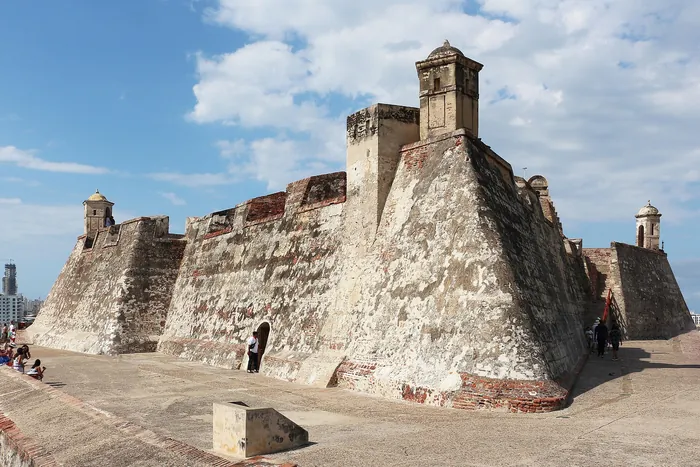
Cartagena has two heights you can see from almost any rooftop. One is the cerro de San Lázaro, with the Castillo de San Felipe de Barajas on top. The other is the cerro de La Popa, with its convent at the summit. This route climbs both in one morning and ends down in Getsemaní at lunchtime. You don't walk between stops: you take a taxi.
Start early. Neither climb has much shade, and the midday sun in Cartagena is unforgiving.
San Felipe: a fortress shaped by its hill
The fortress stands northeast of the Centro Histórico, on a hill about 40 meters high. According to the official fortifications website, its construction was ordered by a Royal Decree of September 20, 1647, and the first section, designed by the Dutch engineer Ricardo Carr, was finished on October 12, 1657. It was a triangular fort at the summit, with four sentry boxes, a cistern and 15 cannons.
It did not withstand everything that came its way. In 1697 the Frenchman Jean-Bernard Desjeans, Baron de Pointis, took it, and Juan de Herrera y Sotomayor later repaired it. In 1741 it repelled the English attack led by Edward Vernon.
What you walk through today is mostly the work of Antonio de Arévalo. Between 1762 and 1769 the engineer built batteries around the original core: San Carlos y Los Apóstoles, the Hornabeque, La Cruz, Santa Bárbara, La Redención and San Lázaro, with 63 cannons in all. Arévalo also dug galleries and covered passages to move troops, underground barracks for 350 men and, in the San Lázaro battery, three cisterns holding 72,000 rations of water each. In 1984 UNESCO added the Centro Histórico, its fortifications and the fortress to the World Heritage List.
At the top you understand what all that stone was for: from the batteries you see the whole city. A map comes with your ticket, and guides or audio guides can be hired at the ticket office. There are steep ramps and stairs, so the management asks visitors to wear comfortable clothes and shoes, drink water and protect themselves from the sun, which is strongest at midday. According to the official website, it opens Monday to Sunday from 8 a.m. to 6 p.m.; confirm before you go. Entry is free on the last Sunday of each month, except in January and December.
La Popa: the highest point
From the fortress to the convent you need a taxi. There is no public transport to the top, and walking up is long and tiring. The Brazilian guide 360meridianos recommends agreeing on a fixed round-trip fare before you leave, so you are not stuck at the top with no way down.
The hill is 148 meters high and is the highest point in the city. The convent was first built in 1607 for the Augustinian order. Before that, according to tradition, the summit held a shrine to the god Buziraco. The most repeated story says that Fray Alonso de la Cruz Paredes hurled the goat-shaped idol over the edge, which is where the name Salto del Cabrón comes from. Historian Rodrigo Alfaro, quoted by El Universal, calls that story a historical falsehood and argues that Buziraco was a god who watched over the bay, not a demon.
The site was also used for military purposes for a long time and was nearly destroyed in 1816, in the middle of the war of independence. In 1986 Pope John Paul II blessed it. Today the visit goes through the ticket office, the sanctuary, the convent and the museum courtyard: a cloister full of flowers, the chapel of the Virgen de la Candelaria, patron saint of Cartagena, and a museum of religious objects. From the lookout you can see the walled city, La Boquilla, the north of the city and, on clear days, the island of Tierrabomba. Mornings usually bring the clearest skies.
Every February 2, for more than 300 years according to El Universal, the image of the Candelaria comes down the hill on the shoulders of her devotees.
Back to Getsemaní
The taxi back drops you at the Plaza de la Trinidad, in the heart of Getsemaní. A local guide quoted by Radio Nacional dates the neighborhood's origin to 1555, when the Franciscans settled at the edge of the walled city, and says it was populated by freed slaves, artisans and poor families. The plaza takes its name from the Iglesia de la Santísima Trinidad, which faces it.
That same guide says Cartagena's independence was born here. On November 11, 1811, the Lanceros de Getsemaní took the Palacio de Gobierno, El Universal recalls. One of the movement's driving forces was Pedro Romero, a blacksmith and master at the Arsenal's Maestranza, who appears aged 21 in the 1777 census of Getsemaní. He is Cartagena's faceless hero: no portrait of him survives, and for an old bust in the plaza the sculptor Héctor Lombana had the painter Alejandro Obregón pose. Today a sculptural group by Nora Quintana shows him with his fist raised, alongside Padre Umaña and a drummer.
By day the plaza is quiet; at night it fills with people, music and food stalls. At lunchtime, after two climbs, all you need is to find some shade nearby.
- 1
Castillo de San Felipe de Barajas
Tunnels, ramps and the whole city at your feet. Go early, before the sun gets strong.
- 2
Convento de la Popa
The highest point in the city: the bay and the neighborhoods at a single glance.
- 3
Back to Getsemaní
Head down to the neighborhood for lunch.
The best time to go
From 8 am, before the strong sun. The sky is usually clearer in the morning for the view from La Popa.
What to bring
Comfortable shoes, water, a hat, sunscreen and cash for the taxi.
How long to spend at each stop
- Castillo de San Felipe de Barajas — an hour and a half to two hours
- Convento de la Popa — around an hour
- Back to Getsemaní — lunch, unhurried
Where to stop and eat
The route comes down to Getsemaní for lunch, when Plaza de la Trinidad is quiet. If you would rather sit down with time, ask the taxi to carry on to Casa Salvaje, on Calle Santa Teresa: Kanibal opens from noon, and from 11 am on Sundays.
Shade and water
Neither climb has much shade, and the castle has ramps and stairs in the sun. The management asks visitors to drink water and protect themselves: the sun is strongest at midday.
At night
Not a night route. The castle is open 8 am to 6 pm and the convent, according to El Universal, 8 am to 5:15 pm. There is no public transport to La Popa: go and come back by taxi, with an agreed fare.
Accessibility
San Felipe has steep ramps, tunnels and stairs; it is not an easy visit with reduced mobility. At La Popa the taxi drops you near the entrance.
Frequently asked questions
How much is San Felipe?
According to the official fortifications site, the full fare is COP 25,000 and the general fare, for Colombians with ID, COP 20,000. It includes a map; guides and audio guides cost extra.
Is there a free day at the castle?
Yes: the last Sunday of each month, except January and December, according to the fortifications site.
Can I walk up to La Popa?
Not a good idea: it is long and there is no public transport. The practical option is a round-trip taxi with the fare agreed before setting off.
How much is the La Popa convent?
In 2025 El Universal published a fare of COP 14,000 for adults and COP 12,000 for children. Check at the ticket office.
Nearby
- Parque Espíritu del Manglar · 10 min walk
- Celele · 10 min walk
- Divino · 11 min walk
- Seven 7 Times · 11 min walk
Foto: Bernard Gagnon / Wikimedia Commons (CC BY-SA 4.0)
Sources · 22
- Urbipedia: Castillo San Felipe de Barajas ↗
- Fortificaciones Cartagena: Castillo de San Felipe ↗
- Atlas Obscura: Convento de la Popa ↗
- Lonely Planet: Convento de la Popa ↗
- Evendo / Wikimedia Commons: Plaza de la Trinidad ↗
- OpenStreetMap/Nominatim (coordenadas de paradas, consultado 2026-11-07) ↗
- Fortificaciones Cartagena: Castillo de San Felipe, áreas e historia (1647-1657, baterías de Arévalo) ↗
- Fortificaciones Cartagena: Recomendaciones para la visita ↗
- El Universal: La historia mal contada de Buziraco, el dios que aparecía en La Popa ↗
- El Universal: Entre cumbias y fritos se disfruta la conmemoración de la Virgen (2023) ↗
- El Universal: ¿Va a visitar el Convento de La Popa? Esto es lo que debe saber (2020) ↗
- El Heraldo: La Popa no ha dejado de ser una amenaza (2018) ↗
- 360meridianos: Convento Santa Cruz de la Popa ↗
- Radio Nacional: Getsemaní, historia, cultura y resistencia ↗
- El Universal: Así nos liberamos del yugo español ↗
- El Universal: Pedro Romero, el héroe sin rostro (2017) ↗
- GPSmyCity: Plaza de La Trinidad ↗
- Wikipedia: Convento de la Popa (apoyo) ↗
- Wikipedia: Castillo San Felipe de Barajas (apoyo) ↗
- El Universal: qué lugares visitar en Cartagena, horarios y tarifas 2025 ↗
- Casa Salvaje: Kanibal (horario) ↗
- 360meridianos: Convento Santa Cruz de la Popa (taxi ida y vuelta) ↗