
Routes / 13
San Diego on foot.
Walk the northern corner of the Centro, from the Teatro Adolfo Mejía to Las Bóvedas, through buildings that changed jobs.
San Diego is the northern corner of the walled city: low houses, wooden balconies and small squares between the Centro and the sea wall. This route crosses it in five stops and an hour and a half of strolling, from a theatre that was once a church to a set of barracks that are now shops. Almost everything here has changed jobs, and that is the thread of the walk. It is best done early or late in the afternoon, when the heat eases and the light slants down the streets.
A theatre inside a church
The starting point is the Plaza de la Merced, in front of the Teatro Adolfo Mejía, which the city still calls the Teatro Heredia. According to Pilar Chaves's thesis for the Universidad de Antioquia (2019), it was built inside the walls of the church of La Merced, completed in 1625, and opened in 1911 as the Teatro Municipal. Since 9 July 1998 it has carried the name of the composer Adolfo Mejía, born in Sincé, although the old name never went away. In January 2026 El Universal reported that it would get its first comprehensive structural intervention since the 1998 reopening, without closing completely. You get to know the inside by going to a performance; from outside, it is worth pausing at the façade for a moment before moving on.
Fernández de Madrid and San Diego
A few blocks east is the Plaza Fernández de Madrid, opposite the church of Santo Toribio. It was once called Plaza de los Jagüeyes and Plaza de Santo Toribio, according to the Donde guide. It honours José Fernández Madrid, a patriot who signed the declaration of independence of 11 November 1811. The website El Rincón Colombiano dates the change of name to 1889, the centenary of his birth, and says the marble statue was carved in Genoa. Only a few years ago the park was abandoned; in 2021 El Universal described how the Fundación Centro Histórico adopted it, planted trees and restored more than twenty street lamps. Travel guides identify it with the Plaza de los Evangelios in Love in the Time of Cholera, where Florentino Ariza's courtship of Fermina Daza begins.
Heading north you reach the Plaza de San Diego. The name comes from the convent of the Recollect friars of San Diego, which according to El Universal operated from 1608 to 1821. The cloister later became a nautical school, a prison between 1833 and 1968 and a psychiatric hospital, until in 1976 it became the fine arts school, today Unibac. The same newspaper notes that the Calle del Camposanto takes its name from the cemetery the convent had at the back. In the morning you see students with portfolios and instruments; at night, tables spill into the square.
Santa Clara and Las Bóvedas
On one side of the square stands the former convent of Santa Clara. According to Historic Hotels Worldwide, Doña Catalina de Cabrera donated the land for the Poor Clares in 1621, and the master builder Simón González raised the complex. Religious reforms closed it in 1861. It then served as a charity hospital, a medical school and a prison, and in 1998 it opened as a hotel; today it operates as the Sofitel Legend Santa Clara. Beneath the El Coro bar lies the crypt excavated by archaeologists in the 1940s. García Márquez, then a reporter, watched the tombs being opened, and that gave rise to Of Love and Other Demons (1994). For those not staying there, the bar and restaurants are the easy way to see the cloisters. Behind the convent, the Santa Clara bastion lets you climb onto the wall.
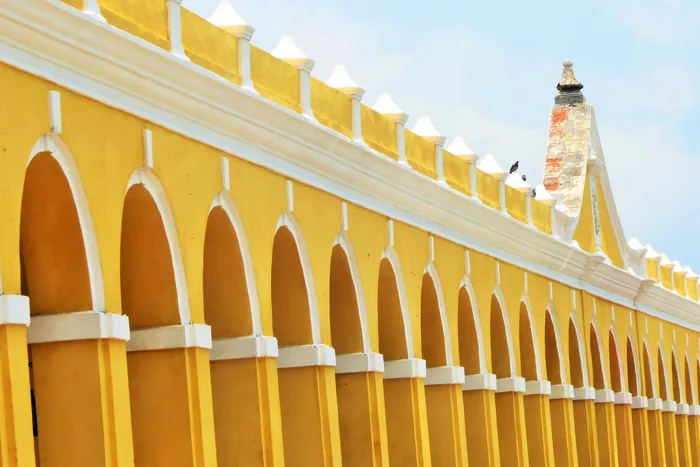
The route ends at Las Bóvedas, set against the wall between the Santa Clara and Santa Catalina bastions, opposite the Colegio Salesiano. According to El Tiempo, Antonio de Arévalo submitted the project in 1773, work began in 1792 and a coat of arms on the central arch marks 1798 as the year it was finished. There are 23 cannon-proof vaults behind a gallery of 47 arches, built to house troops and store supplies; according to Colombia Travel, during the independence wars they served as a prison for patriots. Since the 1970s they have been occupied by craft sellers: hammocks, hats, guayaberas. In 2024 the Escuela Taller Cartagena de Indias, which manages them, was working to recover them. As the afternoon fades, the light passes through the arches and the sea breeze comes over the wall.
Bring water and comfortable shoes. The distances are short, but the San Diego sun shows no mercy at midday.
- 1
Teatro Adolfo Mejía
Start in front of the old Heredia, built inside a church.
- 2
Plaza Fernández de Madrid
Trees, benches and the statue of the patriot who signed the 1811 declaration.
- 3
Plaza de San Diego
The convent that became a prison and is now a fine arts school.
- 4
Former convent of Santa Clara
A Poor Clares cloister from 1621, now a hotel, with its literary crypt.
- 5
Las Bóvedas
Twenty-three vaults against the city wall, to finish with a breeze and crafts.
The best time to go
Early or late afternoon, when the heat eases and the light slants down the streets.
What to bring
Water and comfortable shoes.
How long to spend at each stop
- Teatro Adolfo Mejía — about 10 min
- Plaza Fernández de Madrid — about 15 min, under the trees
- Plaza de San Diego — about 15 min
- Former convent of Santa Clara — about 20 min, more if you go into the bar
- Las Bóvedas — about 20 min
Where to stop and eat
The Teatro Adolfo Mejía, the first stop, is about a 7-minute walk from Casa Salvaje: you can start with lunch at Kanibal, which opens from noon. For those not staying at the Santa Clara, the hotel’s bar and restaurants are the easy way to see the cloisters.
Shade and water
Plaza Fernández de Madrid has trees and benches. The rest of the neighbourhood is sunny streets: at midday it is unforgiving. Bring water.
At night
At night the tables come out onto Plaza de San Diego. Busy areas usually have police presence; avoid empty streets late at night.
Accessibility
The streets are cobbled and flat: walk them with care. Climbing onto the wall at the Santa Clara bastion means stairs and is not wheelchair accessible.
Frequently asked questions
Can I see inside the old Santa Clara convent?
It is a hotel. For non-guests, the bar and restaurants are the easy way to see the cloisters.
Can I go inside the Teatro Adolfo Mejía?
You see the inside by going to a performance: check the IPCC programme.
How long is the route?
About ninety minutes of walking, not counting long stops.
Nearby
- Ábaco Libros y Café · 3 min walk
- Hotel Casa San Agustín · 4 min walk
- Alma · 4 min walk
- Buena Vida Marisquería · 4 min walk
Foto: Picore12 / Wikimedia Commons (CC BY-SA 3.0)
Sources · 15
- Universidad de Antioquia: Pilar Chaves, 'Arquitectura teatral: escenarios que dan forma a la historia de Cartagena de Indias' (tesis, 2019) ↗
- El Universal: Tras 28 años, el Teatro Adolfo Mejía recibirá intervención estructural (ene. 2026) ↗
- Donde Cartagena: Plaza Fernández de Madrid ↗
- El Rincón Colombiano: Plaza Fernández Madrid ↗
- El Universal: El Fernández de Madrid vuelve a cobrar vida (2021) ↗
- Wanderlog: Plaza Fernández de Madrid (El amor en los tiempos del cólera) ↗
- El Universal: La historia que encierra la cárcel de San Diego (2018) ↗
- Historic Hotels Worldwide: historia del Sofitel Legend Santa Clara ↗
- El Tiempo: El plan de la Nación para recuperar monumentos y fortificaciones en manos de particulares (2024) ↗
- Colombia Travel: Las Bóvedas ↗
- OpenStreetMap/Nominatim (coordenadas de paradas, consultado 2026-11-13) ↗
- Casa Salvaje: Kanibal (horario) ↗
- IPCC: Temporada TAM 2026 en el Teatro Adolfo Mejía ↗
- Nomado Travel: murallas de Cartagena (acceso, sombra, accesibilidad, noche) ↗
- Semana: ¿qué tan seguro es el Centro de Cartagena para los turistas? (jul. 2024) ↗