
Routes / 12
Manga on foot.
Cross the Puente Román and walk the island of Manga, between the bay, the Pastelillo fort and its republican-era houses.
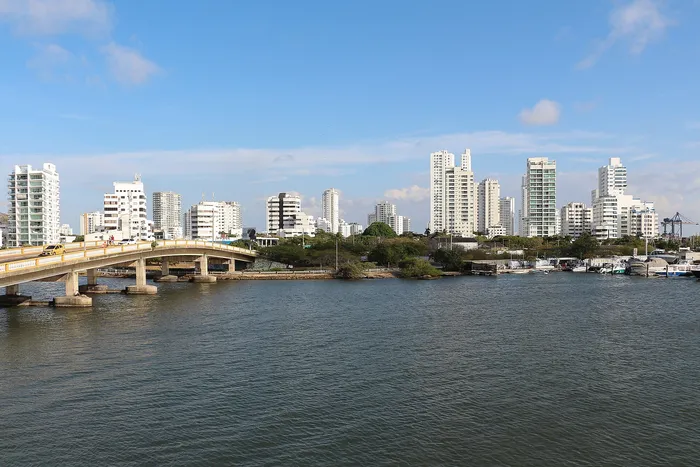
Manga is an island right next to the Centro, and you barely notice until you walk it. This route goes in on foot over the Puente Román, drops down to the docks where the sailboats moor, circles the Pastelillo fort and heads into the inner streets to see one of the remaining villas and the island's oldest cemetery. Allow about two hours, unhurried. It is best to start in mid-afternoon, so that the walk back over the bridge coincides with the last light on the bay.
From the bridge to the sailboats
The starting point is the edge of Getsemaní. The Puente Román, which appears on maps as the Puente Henrique L. Román, crosses the water to Manga and is the most direct way to get there on foot from the Centro. From the walkway you see the bay and, ahead, the island's shore with its towers and trees.
Coming off the bridge, the Club de Pesca docks are on your right. Here the island faces the water: yachts, launches and sailboats are moored, masts rattle in the breeze and people work on ropes. It is not a shopping walk but a place to look at boats and understand that Cartagena is also a port for sailors. The club's restaurant has its own jetty on the bay, where boats tie up to drop off or pick up passengers, according to a piece by the restaurant itself in El Universal.
The Pastelillo, at water level
A few steps away is the fort of San Sebastián del Pastelillo. According to Fortificaciones de Cartagena, it was built between 1741 and 1744 on the orders of Viceroy Sebastián de Eslava, to plans by the engineer Juan Bautista Mac Evan, with construction directed by Carlos Desnaux. It occupies the site of the city's first fort, El Boquerón, and its job was to watch the entrance to the Bahía de las Ánimas and the land route from Manga. San Sebastián is a nod to the viceroy; Pastelillo, to its low, flattened, pie-like shape. It has a wall with embrasures, a cistern, a storehouse and a jetty, and was restored in 1972 by the architect Juan Manuel Zapatero.
Today it is not a museum: the Club de Pesca's restaurant operates there. The arrangement has had its frictions. In August 2021 yellow paint was applied to the walls without authorisation, and El Heraldo reported in 2022 that the Ministry of Culture fined the club 281 million pesos. By then the paint had already been removed: in October 2021 El Universal showed the restoration, led by the architect Alberto Samudio Trallero and reviewed by the ministry. From outside, walking along the water, you get a good view of the fort's low profile.
An Andalusian villa
From the fort, the route heads inland to Calle 25, home to the Casa Román. It is one of the Arab-inspired houses that made Manga famous. According to El Universal, Henrique Pío Román and his wife came back from Spain dazzled by the Alhambra and Seville's architecture and wanted to recreate it in Cartagena; the newspaper dates the opening of its doors to 1919, and AramcoWorld magazine places the work between 1919 and 1931. Their daughter, Teresita Román, was one of the first to defend the city's architectural heritage. It is a private house, seen from the street.
The house is part of the republican-era villas built on the island in the early 20th century. Another well-known one, the Casa Cavelier, stands on Segunda Avenida: according to El Universal, it was designed by the Spanish architect Miguel Arquer and built between 1926 and 1927. The same article noted that the Casa Román, the Casa Covo and Villa Susana are listed as national heritage properties, and quoted a restorer lamenting the mansions that have been disappearing.
The 1824 cemetery
The last stop is the Cementerio de Santa Cruz de Manga, on Cuarta Avenida. It opened on 24 November 1824, according to the restoration architect Juan Manuel Lara Ruiz, quoted by El Universal, and is considered the island's first architectural work after the forts. It covers about a hectare and a half, with some 150 mausoleums, and holds the tomb of Juan José Nieto Gil, whom El Universal remembers as Colombia's only Black president. It has been a National Monument since 1995, and in 2023 its inclusion in the national network of heritage cemeteries was approved.
Visit in daylight and with respect: burials still take place and deterioration has been a problem for years. To get back, the same bridge returns you to Getsemaní. Bring water and a hat; Manga has more tree shade than the Centro, but the afternoon sun is just as strong.
- 1
Puente Román
Walk onto the island from Getsemaní, with water on both sides.
- 2
Club de Pesca docks
Sailboats and yachts moored at the foot of the fort.
- 3
Fuerte del Pastelillo
A low fort, almost at water level, built after 1741.
- 4
Casa Román
The Andalusian-style villa that sums up early 20th-century Manga.
- 5
Cementerio de Manga
The island's first civic building, opened in 1824.
The best time to go
Mid-afternoon, so you cross back over the bridge at sunset.
What to bring
Water, a hat and comfortable shoes.
How long to spend at each stop
- Puente Román — about 10 min
- Club de Pesca docks — about 15 min
- Fuerte del Pastelillo — about 20 min, along the water
- Casa Román — about 10 min, from the street
- Cementerio de Manga — about 30 min
Where to stop and eat
Inside the Pastelillo fort is the Club de Pesca restaurant, with its own jetty on the bay. When you walk back over the bridge, Casa Salvaje is about 18 minutes away on foot: SLVJ serves dinner from 7 pm.
Shade and water
Manga has more tree shade than the Centro, but the afternoon sun hits just the same. Bring water and a hat.
At night
The cemetery is for daytime. Ideally, your walk back over the Puente Román coincides with the last light over the bay.
Frequently asked questions
Can I go inside the Pastelillo fort?
It is not a museum: the Club de Pesca restaurant operates there. From outside, along the water, you can appreciate its low profile.
Can I visit the Casa Román?
It is a private house. You see it from the street.
How do I walk to Manga?
Over the Puente Román, from the edge of Getsemaní.
Nearby
- Salón Tropical · 4 min walk
- Cervecería Cartagena · 5 min walk
- Café del Mural · 6 min walk
- Casa Palenque · 6 min walk
Foto: Bernard Gagnon / Wikimedia Commons (CC BY-SA 4.0)
Sources · 11
- Fortificaciones de Cartagena (Escuela Taller): San Sebastián del Pastelillo ↗
- El Universal: Está listo, así quedó restaurado el fuerte San Sebastián del Pastelillo (oct. 2021) ↗
- El Heraldo: Imponen millonaria sanción contra el Club de Pesca de Cartagena (oct. 2022) ↗
- El Universal: Restaurante Fuerte San Sebastián del Pastelillo, historia y tradición (informe empresarial, 2021) ↗
- El Universal: Teresita Román, encanto y sabor de una historia (2021) ↗
- AramcoWorld: The Alhambras of Latin America (2021) ↗
- El Universal: Cavelier, la mansión republicana que se detuvo en el tiempo (2019) ↗
- El Universal: Cementerio de Manga, un muerto muy pesado de cargar (2017) ↗
- El Universal: Cementerio de Manga hace parte de la Red Nacional de Cementerios (2023) ↗
- OpenStreetMap/Nominatim (coordenadas de paradas, consultado 2026-11-13) ↗
- Casa Salvaje: SLVJ (horario) ↗