
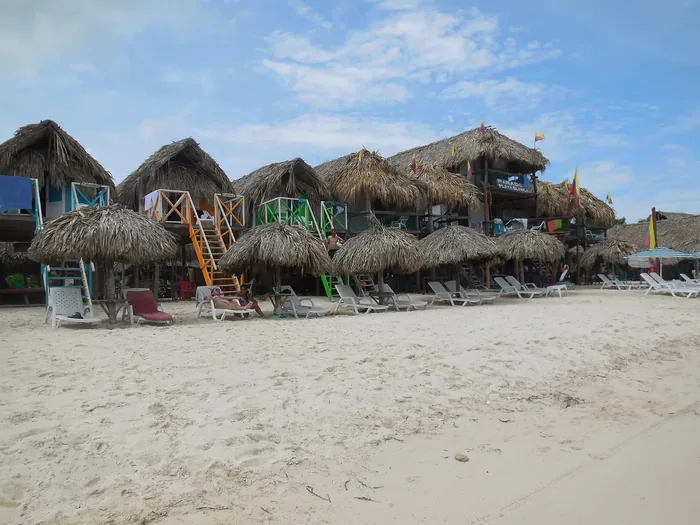
Barú is the land that closes off Cartagena's bay to the south. It is not quite an island: according to National Geographic, the Spanish cut it off from the mainland in the 16th century when they opened the Canal del Dique, and a bridge joined it up again in 2014. Going by road makes for a different day from the boat trip: stopping along the way, seeing a mangrove looked after by its own community, walking among aviaries and ending up on the beach.
The bridge
From Cartagena you leave through the Mamonal industrial zone towards Pasacaballos. El Universal describes the stretch that runs behind that village, just before the Campo Elías bridge, as the only land link to Santa Ana, Ararca, Barú and Playa Blanca. In 2024 the same paper warned that it had potholes that called for careful driving. The Aviary reckons about 50 minutes from the city to its entrance. It also gives a useful warning: near the bridge, the Ararca turn-off and the Aviary itself, people wave at cars to offer guiding to Playa Blanca. There is no need to stop.
Ararca and its mangrove
The first stop is Ararca, a fishing village surrounded by lagoons and mangrove. There the community corporation Tuarisba, founded in 2017 and turned into a tourism agency in 2020, runs a tour with several stops, according to El Universal: the Casa del Pescador, the community nursery, the Tucu-Tucu trail through the mangrove, Los Coquitos beach facing Tierra Bomba, and the Cocón lime kiln. In the nursery, run mostly by single mothers, some 15,000 red and black mangrove seeds are germinated and later planted by fishermen. Every visitor plants a mangrove.
The kiln deserves a pause. It made lime from coral stone, and that lime was a raw material for Cartagena's fortifications. The same paper says the city had more than 40 lime kilns and that Cocón's is the best preserved. Groups are of 5 to 10 people, so book ahead and bring shoes that can get wet.
The National Aviary
Further south, at kilometre 14.5 of the road, is the Aviario Nacional de Colombia. It opened in February 2016 and, according to Publimetro, holds more than 2,000 birds of about 200 species on almost eight hectares, along a 1.7-kilometre trail with 22 habitats. Many arrived from seizures and rescues by environmental authorities; the flamingos started with 49 recovered birds and now number about 180. According to its website, it opens every day from 9 a.m. to 5 p.m., with last entry at 4, and there is a flight show at 11:30 and 3:30, weather permitting. No food is allowed in, only water, and feeding the birds is forbidden. Mobile signal is weak on Barú.
Playa Blanca, by day and by night
The last stop is Playa Blanca, Barú's best-known beach. According to El Universal, it is part of the Corales del Rosario y de San Bernardo National Natural Park, so accident and assistance insurance is required there too; in June 2026 Parques Nacionales, the Tourism Department and the police carried out checks. Arrive early, agree prices before you sit down or order, and take your rubbish with you.
If you stay into the night you can see bioluminescent plankton. El Universal describes a boat trip from the shore of Playa Blanca, at around 7 p.m., to the Portonaito lagoon, also called the Laguna Encantada: a body of water ringed by mangrove, two to three metres deep, where the water lights up blue when you move it. The intensity changes with the season. A marine biologist quoted in that piece advises going with people who know the place, because sailing at night is not easy. Wear a life jacket.
Barú has other sides. National Geographic describes Cholón as a mangrove-fringed bay where herons fish in the shallows. But for a day by road, these four stops are enough. Set off early and, if you are not staying for the plankton, head back in daylight.
- 1
The bridge
Pasacaballos and the crossing of the Canal del Dique into Barú.
- 2
The Ararca mangrove
A canoe, a community nursery and a colonial lime kiln.
- 3
The National Aviary
More than 2,000 birds along a 1.7-kilometre trail.
- 4
Playa Blanca
Pale sand by day and, at night, plankton in the Portonaito lagoon.
The best time to go
Set off early. The Aviary opens every day from 9 am to 5 pm, last entry at 4, and its flight show is at 11:30 am and 3:30 pm, weather permitting.
What to bring
Water, a cap, sunscreen, shoes that can get wet, cash and the accident and assistance insurance required at Playa Blanca. Mobile signal is weak on Barú.
How long to spend at each stop
- The bridge — about 50 min by road from the city
- The Ararca mangrove — about two hours, with the community tour
- The National Aviary — about two hours for the 1.7 km trail
- Playa Blanca — the rest of the afternoon
Where to stop and eat
You cannot take food into the Aviary, only water. At Playa Blanca, agree prices before sitting down or ordering. Back in the city, Casa Salvaje is in the Centro: Kanibal takes last orders at 11 and SLVJ serves dinner from 7 pm.
Shade and water
The Aviary trail and the beach have sunny stretches. Bring water, a cap and sunscreen.
At night
If you stay, you can take a boat from Playa Blanca around 7 pm to see bioluminescent plankton in the Portonaito lagoon. Go with people who know the place, because navigating at night is not easy, and wear a life jacket. If you are not staying, head back in daylight.
Accessibility
The Aviary trail is 1.7 km long. The Ararca tour goes through mangrove and beach: wear shoes that can get wet.
Frequently asked questions
Do I need to book in Ararca?
It is a good idea: community tour groups are 5 to 10 people.
What time does the National Aviary open?
According to its website, every day from 9 am to 5 pm, last entry at 4.
Should I stop for people offering guides on the road?
No need. The Aviary warns that near the bridge and the entrances people wave cars down to offer guiding to Playa Blanca.
Is insurance required at Playa Blanca?
Yes. It is part of the Corales del Rosario y de San Bernardo National Park, which requires accident and assistance insurance.
Foto: Dasha Shishkova / Wikimedia Commons (CC BY-SA 4.0)
Sources · 12
- El Universal: los 35 kilómetros asfaltados de la vía a Barú (abr. 2024) ↗
- National Geographic: How to explore Cartagena's secret islands ↗
- El Universal: Ararca, cuna del manglar y las murallas coloniales (sep. 2023) ↗
- El Universal: Ararca, la comunidad de Barú que trabaja por sus manglares (jun. 2026) ↗
- aviarionacional.co: información para tu visita (horario, normas) ↗
- aviarionacional.co: el Aviario (presentación de vuelo) ↗
- Publimetro: el Aviario Nacional cumple 10 años (oct. 2026) ↗
- El Universal: Playa Blanca exige seguro obligatorio (jun. 2026) ↗
- El Universal: plancton luminoso, la maravilla escondida en Barú (2019) ↗
- OpenStreetMap/Nominatim (coordenadas de paradas, consultado 2026-11-13) ↗
- Casa Salvaje: Kanibal (horario) ↗
- Casa Salvaje: SLVJ (horario) ↗