
Diving / Before you dive
Diving safety in Cartagena: insurance, emergencies and the hyperbaric chamber
Before your first dive, find out who insures you, what oxygen the boat carries, which number to call and when you can fly.
- Where
- Cartagena, Barú, Tierra Bomba and the Corales del Rosario y de San Bernardo National Natural Park
- Before you go
- Buy the insurance the park requires and, separately, dive insurance that covers evacuation and the chamber. Ask to see the boat's oxygen. Save Coast Guard line 146 and DAN's number in your phone. Leave at least 18 hours between your last dive and your flight. Do not touch lionfish or coral.
Recreational diving is safe when you go with a serious centre, stay within your level and have a plan for when something goes wrong. In Cartagena that plan has local pieces: an insurance policy the park requires, rules for the boats, a maritime emergency number, a military hyperbaric chamber and an airport that almost everyone flies out of after diving.
Insurance: the park's, the centre's and yours
To enter the Corales del Rosario y de San Bernardo National Natural Park, which includes Playa Blanca, Rosario and San Bernardo, the National Parks service requires accident and assistance insurance under its Resolution 273 of 2024. Without it, you do not get in. According to El Universal, it covers primary medical care on site, first-aid posts, land and water ambulances and transfers; the approved insurers are Positiva, in partnership with Magenta, and Zurich. In June 2026 the park had 11 first-aid posts at Playa Blanca, Isla Grande, Múcura and Tintipán. We found nothing saying that this policy explicitly covers diving accidents or chamber treatment: ask first.
Dive companies have their own obligation. Since Resolution 1212 of October 2025, Dimar, the maritime authority, requires them to hold a compliance bond worth 100 monthly minimum wages, which guarantees they follow the law. Civil liability insurance is no longer part of that rule. Dimar justified the change by citing DAN reports: most diving accidents are caused by human error, technical failure or the diver's own medical conditions, and do not affect third parties. In practice, that makes your own dive insurance, covering evacuation and recompression, more important. Some centres include one in their packages; ask for the policy and read what it covers.
On the boat and in an emergency
Dimar's Resolution 0580 of 2020 sets the minimum equipment for commercial dive boats: enough oxygen to cover the trip from the farthest point to the evacuation point, calculated at 15 litres per minute, a first-aid kit, the Alfa flag, a ladder or platform for divers to climb aboard, a system to secure the tanks and another to time the dive. Asking to see the oxygen before leaving is not distrust.
If after diving you feel unusual fatigue, itching, joint pain, dizziness, tingling, weakness or shortness of breath, it may be decompression sickness. DAN says to give oxygen immediately, 100 % in serious cases; call emergency services and then DAN's line, +1-919-684-9111, which answers 24 hours a day and accepts collect calls; for Spanish, DAN lists +52-557-100-0540. Even if symptoms ease with oxygen, a medical evaluation is needed: they can come back. At sea, the Navy handles emergencies on Coast Guard line 146 and on VHF radio channel 16. Cartagena's Port Authority investigates maritime accidents.
Treating decompression sickness requires a hyperbaric chamber. In Cartagena, the Naval Hospital opened the Centro Hiperbárico del Caribe, with two multiplace chambers, to treat decompression sickness and gas embolism, according to the Armed Forces. It is meant for users of the military health system; for the general public, the announcement said rates and hours would be published later. We found no verifiable public information about any other chamber for divers in the city. Ask the centre what its evacuation plan is and where it would take an injured diver.
Flying after diving
Almost everyone who dives in Cartagena leaves by plane. DAN's guidelines call for at least 12 hours at the surface before flying after a single no-decompression dive, at least 18 hours after several dives in a day or several days in a row, and substantially more than 18 after decompression dives. Even then, there is no guarantee; with symptoms, do not fly. The practical answer: keep the last day of your trip dive-free.
Lionfish, fire coral and currents
Lionfish are an invasive species in the Caribbean and their spines are venomous. Do not touch one, even if it stays still. If someone is stung, DAN recommends washing with soap and fresh water, removing visible debris and soaking the area in water as hot as can be tolerated, no hotter than 45 °C, for 30 to 90 minutes. The helper should test the water on their own skin, because pain distorts judgment. Afterwards a medical evaluation is needed, and if symptoms are severe, call emergency services.
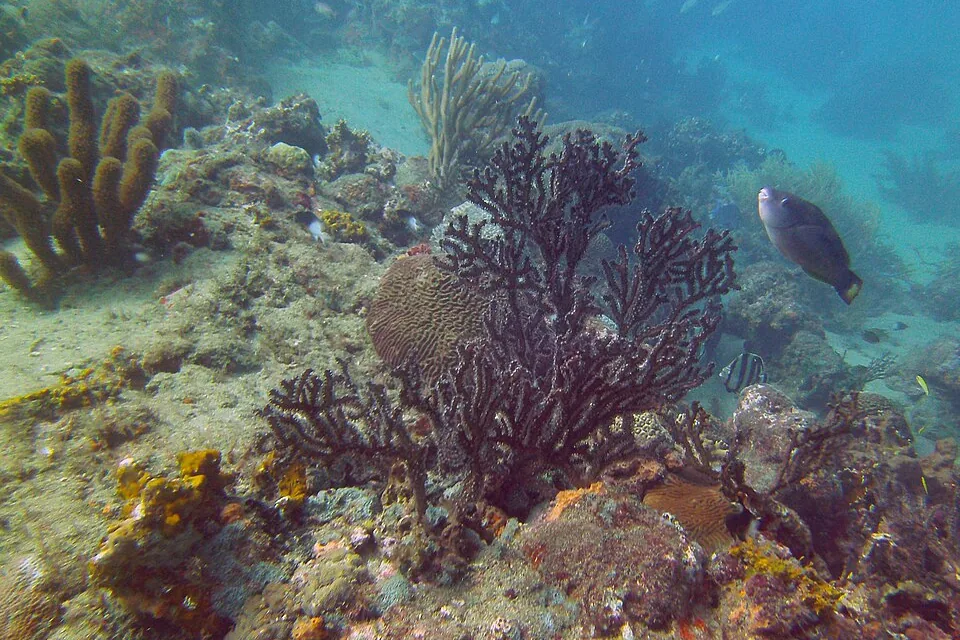
Fire coral, common on the area's reefs and wrecks according to ProColombia, burns on contact: another reason not to touch anything. Some sites have strong currents, such as Salmedina or Bajo Burbujas, according to Colombia Travel, and are for advanced divers. Near the bay and between the islands there is boat traffic: ascend slowly, looking up, close to the buoy or the boat.
Hours, prices and conditions can change: confirm with the organizer or the venue before you go.
Sources
- El Universal (14 ene. 2026): Alcaldía y Parques Nacionales aclaran cobro de seguro en Islas del Rosario ↗
- El Universal (16 jun. 2026): Playa Blanca exige seguro obligatorio, Parques Nacionales verifica cumplimiento ↗
- Dimar: Resolución 1212 de 2025 (seguro de las empresas de buceo recreativo) ↗
- Dimar: Resolución 0580 de 2020 (naves de buceo recreativo: oxígeno y equipo mínimo) ↗
- DAN: Treating Decompression Sickness (síntomas y primeros auxilios) ↗
- DAN: líneas de emergencia ↗
- DAN: Flying After Diving (pautas de 12 y 18 horas) ↗
- DAN / Alert Diver: Lionfish Stings ↗
- Comando General de las Fuerzas Militares: Hospital Naval de Cartagena inaugura el Centro Hiperbárico del Caribe ↗
- Dimar (29 jul. 2024): Armada y Dimar atienden emergencia en la bahía interna de Cartagena (línea 146 y canal 16) ↗
- ProColombia / Colombia Travel: Guía especializada de buceo en Colombia (2024), coral de fuego en Cartagena ↗
- Colombia Travel: buceo en Cartagena (corrientes en Salmedina y Bajo Burbujas) ↗
Diving in Cartagena: reefs, shipwrecks and the story of the sea →