
Diving / Marine life and conservation
Restoring the coral: nurseries, spawning and bleaching in the Rosario Islands
Tree nurseries, steel beds and lab-reared larvae: how biologists, islanders and divers are trying to help the Rosario reef survive the heat.
- Where
- Corales del Rosario y de San Bernardo National Natural Park: Isla Grande, Isla Tesoro, San Martín de Pajarales island (Oceanario) and the San Bernardo archipelago
- When to go
- Most corals reproduce sexually only once a year, according to UNRIC; in the Rosario Islands, the documented gamete collections took place in May (2023) and June (2024).
- Before you go
- Do not touch the coral or lean on it. Choose a centre that uses mooring buoys. If you see bleached coral, photograph it and send it to Invemar (correspondencia@invemar.org.co), as the Ministry of Environment asks. If a centre offers you coral planting, ask which institution it works with and under what park permit.
The Rosario reef is not recovering on its own. The Oceanario de las Islas del Rosario has worked on coral restoration for more than fifteen years, according to Mongabay, and today biologists from other institutions, islanders, dive centres and the Navy also plant coral. They do so in an area that, according to its head in 2023, John Deiver Jiménez, holds 84% of the coral reefs on the country's continental shelf. The 2020 management plan states that restoration work, including participatory restoration, is allowed in the recreation zones under the park's direction.
The state of the reef
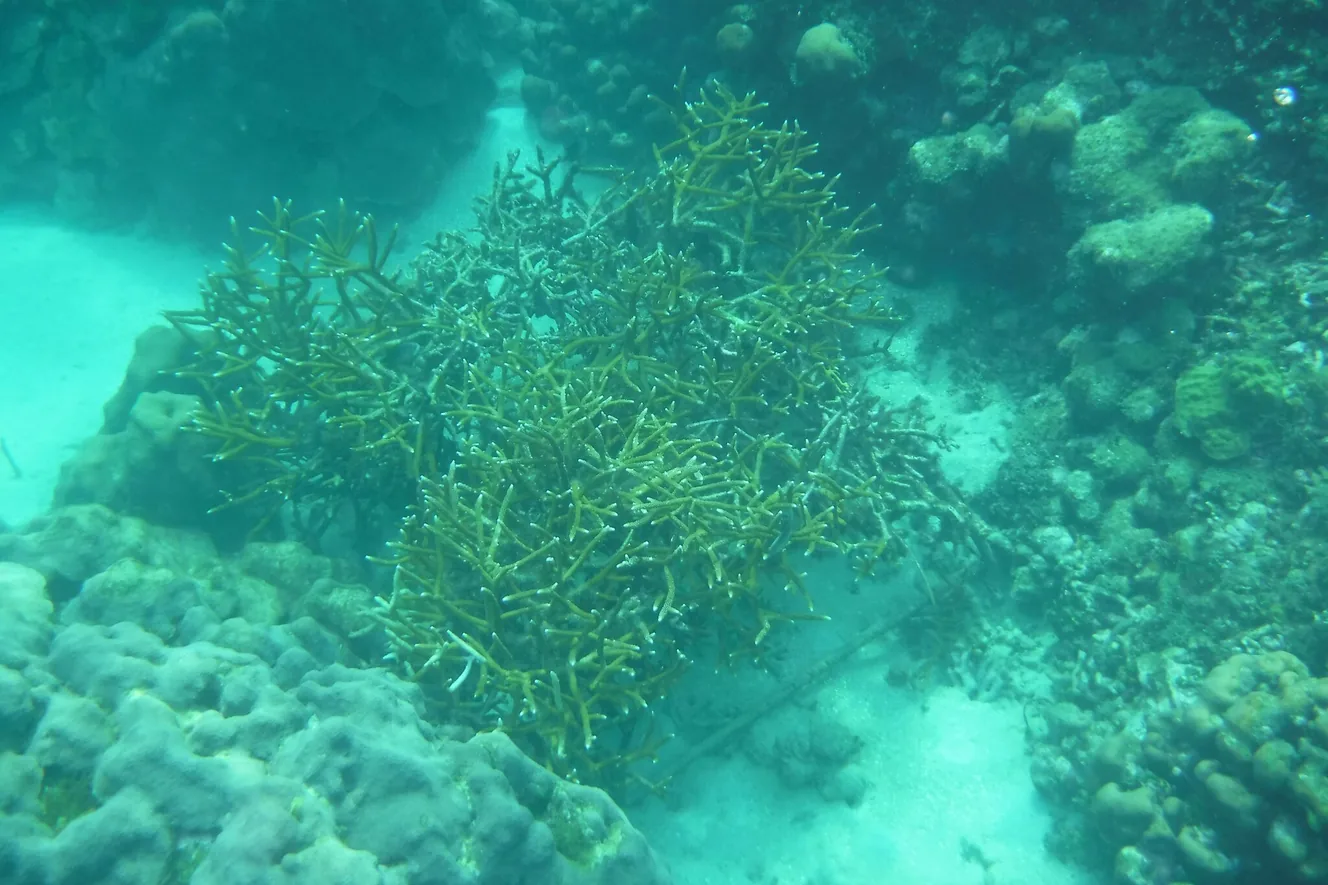
Elkhorn and staghorn corals (Acropora palmata and Acropora cervicornis), the branching corals that built the shallow reefs, were common until the 1980s and suffered a massive decline in the Colombian Caribbean, Mongabay reported in June 2026. In that report, biologist Rocío García Ureña, of the Universidad del Magdalena, said that not a single elkhorn coral is left on the reef crest at Isla Grande. Lavinia Fiori, of the Community Council of the Rosario Islands, said that in 2023 everything the community had restored bleached, including a six-year-old elkhorn coral.
2023 was a year of alarm. On 22 November 2023, the Ministry of Environment warned that between 70 and 80% of the country's reefs were showing bleaching because of a heatwave in the Gulf of Mexico and the Caribbean, and it named this park and the Varadero reef. Coral bleaches when it expels the microalga that lives in its tissue and supplies about 90% of its energy; if the heat lasts, it dies. The Ministry recommended suspending restoration work in areas on alert and moving nurseries to deeper or cooler water.
For San Bernardo there is a finer measurement. Invemar's coral condition index rated the archipelago as fair in 2024: live coral cover fell 14% compared with the previous year because of bleaching, with temperatures of 32.5 degrees, and yellow band disease, which attacks massive corals of the genus Orbicella, while macroalgae increased.
Coral nurseries and gardens
The best-known technique is gardening: cutting fragments, raising them in nurseries and transplanting them. On San Martín de Pajarales island, home of the Oceanario, the Research, Education and Recreation Centre (Ceiner) tested vertical tree nurseries with five variants of staghorn coral. A study published in 2019 in the journal Mutis, of the Universidad Jorge Tadeo Lozano, reported survival of between 90 and 100% of the fragments, and identified algal overgrowth as the most frequent cause of partial mortality. Today the Oceanario keeps more than 40,000 corals grown out of the sea, some of them genotypes that no longer exist on the reef, according to Mongabay.
In November 2022, the United Nations Regional Information Centre (UNRIC) described how it was done. At the Oceanario there are tree and rope nurseries for branching species, which grow fast, and table nurseries for microfragmenting slow-growing species. At Isla Tesoro, divers were installing steel beds one metre above the bottom, at about six metres deep, so that sediment would not smother the fragments. Slow species take between a year and a year and a half to be ready, and the article estimated that between 70 and 80% of transplanted coral survives.
That work fed into the national programme One Million Corals for Colombia. In June 2023, the Ministry of Environment counted 735,822 new fragments of more than 30 species in twelve areas of the Caribbean and the Pacific, this park among them, and 91,191 already returned to the reef. According to Mongabay, the programme closed its 2021 to 2023 phase with about 1,050,000 fragments over some 204 hectares.
Larvae for genetic diversity
Fragments are clones of the parent colony. To recover genetic diversity, teams collect the gametes corals release in their annual spawning, fertilise them in the lab and plant the larvae. In May 2023, Ecomares, National Parks, the Oceanario, the Universidad del Magdalena, Diving Planet and Secore International collected brain coral gametes (Diploria labyrinthiformis) in the park. At the Oceanario they obtained 5,099 polyps, which were transplanted in June to the Isla Grande barrier reef. In June 2024, Navy divers repeated the collection with Ceiner near Isla Grande. And in 2024, García Ureña found an elkhorn coral spawning on a coral patch, which helped improve assisted fertilisation.
How a diver can help
You do not need to plant coral to help. The first thing is not to touch it: the Ministry of Environment asks this explicitly and lists diving over reefs, high-speed boating and anchoring among the pressures that need to be reduced. Dive with a certified centre that ties up to mooring buoys, because Resolution 273 of 2007 forbids anchoring on coral or seagrass, and mind your buoyancy. If you see bleached coral, the Ministry asks you to photograph or film it and send it to Invemar at correspondencia@invemar.org.co. And if you want to take part, ask: National Parks acknowledges that tourism businesses and environmental interpreters in the park already work on coral and mangrove restoration.
Los corales que se intenta recuperar (2)
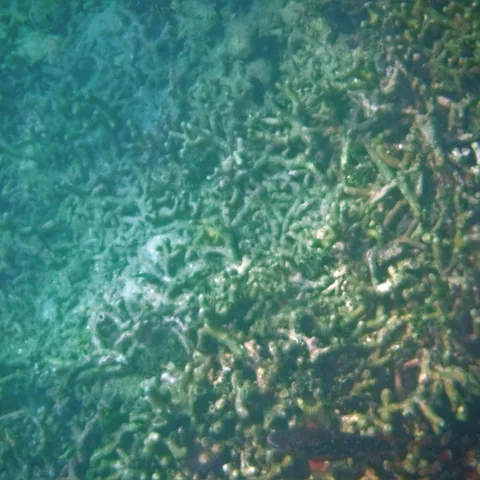
Staghorn coralAcroporaFoto: Louis Imbeau / iNaturalist · CC BY 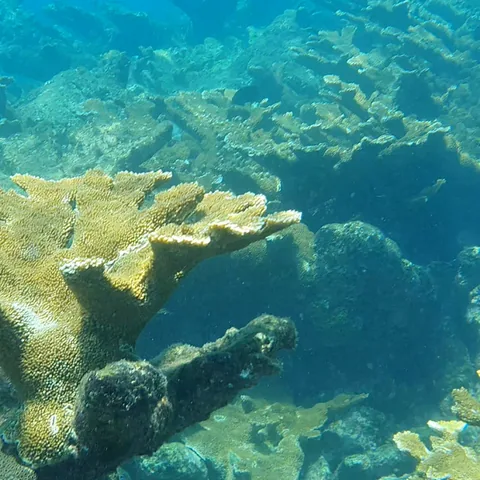
Elkhorn coralAcropora palmataFoto: Michael Cantillo / iNaturalist · CC BY · Santa Marta, foto ilustrativa
Hours, prices and conditions can change: confirm with the organizer or the venue before you go.
Sources
- Mongabay: Acróporas, corales que desaparecen en el Caribe colombiano (junio de 2026) ↗
- Ministerio de Ambiente: alerta por blanqueamiento de arrecifes (22 de noviembre de 2023) ↗
- Ministerio de Ambiente: Corales son trasplantados para restaurar arrecifes en Isla Grande (8 de junio de 2023) ↗
- Invemar: Boletín ICTAC, Archipiélago de San Bernardo, reporte 2024 ↗
- Zárate, Jáuregui y Rojas: Evaluación de morfotipos de coral Acropora cervicornis en guarderías colgantes para restauración, revista Mutis (2019) ↗
- UNRIC (Naciones Unidas): COP27, Un millón de corales por Colombia (2022) ↗
- Fuerzas Militares de Colombia: Buzos de la Armada y el Ceiner propician la reproducción de corales (junio de 2024) ↗
- Parques Nacionales Naturales: balance de ecoturismo del PNN Corales del Rosario y de San Bernardo (2024) ↗
- Parques Nacionales Naturales: Plan de manejo del PNN Corales del Rosario y de San Bernardo (2020) ↗
- Parques Nacionales Naturales: Resolución 0273 de 2007 ↗
Diving in Cartagena: reefs, shipwrecks and the story of the sea →