
Diving / Rules and reef care
Diving in the Corales del Rosario y de San Bernardo National Natural Park: rules and reef care
What the park protects, where you can dive, what is banned and the state of the coral you are about to see.
- Level
- The 2020 management plan allows snorkelling with basic gear and recreational Open and Advanced diving, only at authorized sites.
- Where
- Caribbean Sea southwest of Cartagena, between the coasts of Bolívar and Sucre: the Nuestra Señora del Rosario and San Bernardo archipelagos and part of Barú
- Getting there
- By sea only, with licensed operators. Under Resolution 273 of 2007, tourist boats must carry an authorized guide, and dive boats a skipper, a mate and a dive flag.
- When to go
- Year-round, with water at about 28 °C (Colombia Travel). The park may close sites for environmental or administrative reasons, under Resolution 273 of 2007: check before you go.
- Before you go
- Go with licensed operators and ask them which authorized site you will visit. Pay the entry fee and buy travel assistance insurance. Insist on a buoy mooring. Touch nothing, take nothing and feed nothing. Use reef-friendly sunscreen. Report bleached coral to Invemar (correspondencia@invemar.org.co) with photos or videos.
The park was born on 6 June 1977, when a government resolution approved the Inderena agreement that declared about 17,800 hectares off Cartagena as the Los Corales del Rosario National Natural Park. In 1996 the Ministry of the Environment enlarged it to about 120,000 hectares, added the San Bernardo archipelago and gave it its current name. Almost all of it is sea. A May 2026 guide in El Espectador counts 53 species of reef-building corals, at least 167 fish species and more than 1.6 million visitors a year.
Today it is governed by the management plan Parques Nacionales adopted in May 2020. Its first goal is to protect coral reefs, seagrass meadows and mangroves. The plan is run jointly with the community councils of Islas del Rosario, Santa Cruz del Islote, Ararca, Playa Blanca, Barú and Santa Ana, Black communities living in the park's area of influence.
Zones and authorized sites
The plan divides the park into zones. In the untouchable zone only research and monitoring are allowed: it covers Isla Tesoro and the sea around it, the submerged part of Isla Rosario down to 30 metres and Isla Mangle, in San Bernardo, within a 1,000-metre radius. There are natural recovery zones, meant to let degraded ecosystems recover, and recreation zones. In the latter, swimming, snorkelling with basic gear and safety equipment, and recreational Open and Advanced diving at the sites set by Resolution 273 of 2007 are allowed.
That resolution is the list worth knowing. For snorkelling it authorizes, in the Rosario Islands, Bajo Luis Guerra 1 and 2, Punta Brava and San Quintín; in San Bernardo, Columpios, Galpas and Llantas. For scuba, in the Rosario Islands, Pavitos 1 and 2, Isla Fiesta and a point called Sur Oeste; in San Bernardo, Bajo Isa, Bajo Medio 2 and Dapena. All have coordinates. Some heavily used trails, such as Ministerio or Isla Gloria, do not appear under those names; ask your operator which authorized site you will visit.
The resolution also regulates boats. Dive boats must carry a skipper and a mate, fly the blue flag with a white diagonal stripe that signals divers below, slow down on arrival and tie up to the buoy; if several arrive, they raft up to one another. They may anchor only on sand when there is no buoy or pier, and never on coral or seagrass. Park staff may accompany any group without notice, and their instructions are binding.
What is banned
The general rules for national parks come from Decree 622 of 1977, whose article 30 lists prohibited conduct. Among it: dumping toxic or polluting substances, fishing except for authorized scientific purposes or in zones where the authority allows sport or subsistence fishing, collecting plants, introducing animals or plants of any species, throwing away rubbish, making noise that disturbs the environment and moving signs or buoys. In the water that boils down to something simple: take nothing, leave nothing and touch nothing.
Jet skis, inflatable rings and towed banana boats are not allowed in the park either, as Parques Nacionales reminded the public in March 2026 after a tourist died in a boating accident. The agency asked operators to offer only permitted activities and to carry insurance, and visitors to buy travel assistance cover. Paying the entry fee matters too: in a 2024 review, the park acknowledged that on average only 33% of those who enter pay it.
The state of the coral
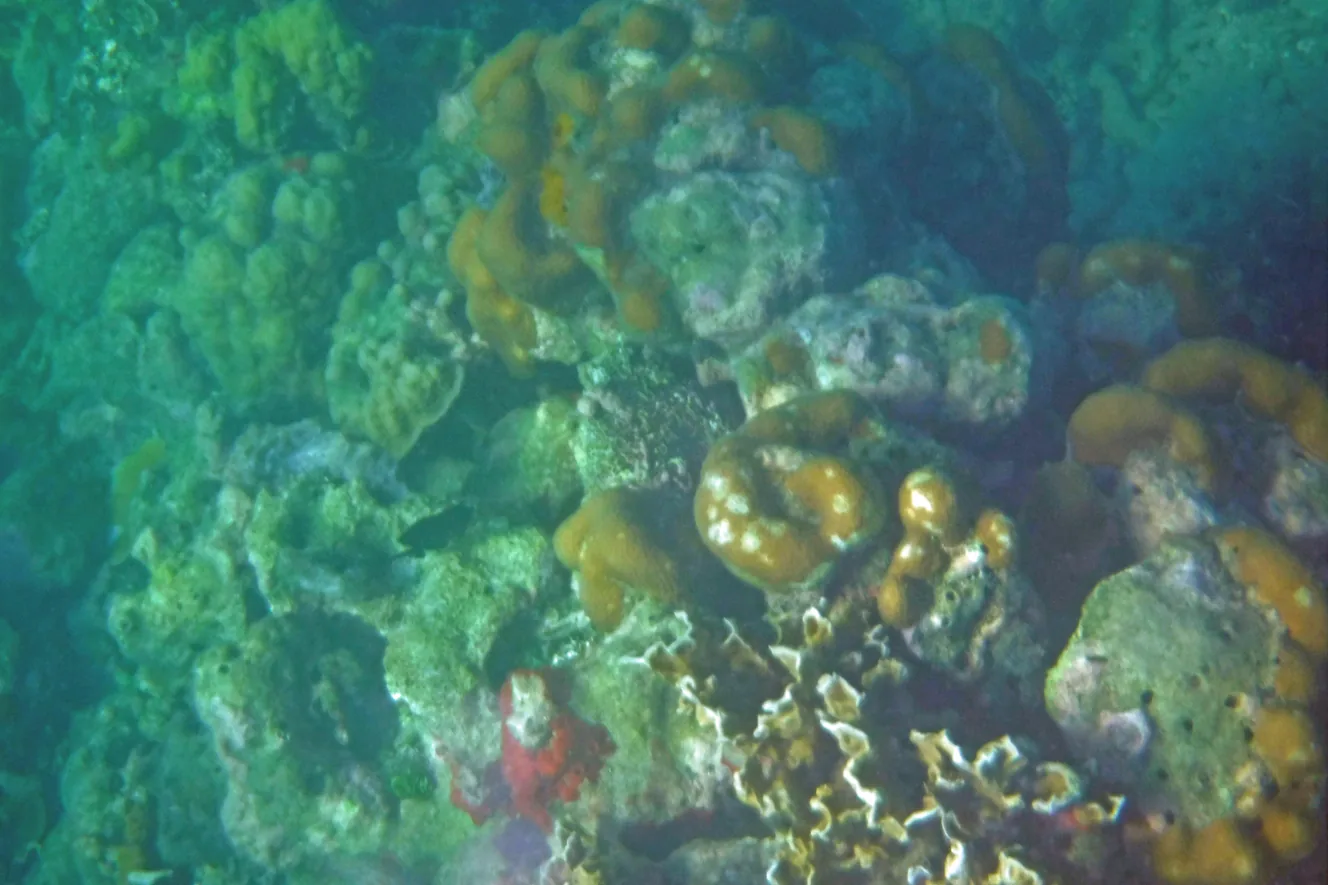
The reef you will see has lost a great deal. In 2018 Mongabay cited Parques Nacionales as attributing the death of about 80% of the corals of Rosario and San Bernardo to sediment from the Canal del Dique. In November 2023 the Ministry of Environment warned that 70% to 80% of the country's reefs had bleached in a heatwave, and named this park. Bleached coral expels the microalga that feeds it; if the heat lasts, it dies. In June 2026 the Community Council of the Rosario Islands estimated for Mongabay that 60% of its reef down to 10 metres had died since 2023.
There is recovery work under way. The Oceanario of the Rosario Islands keeps more than 40,000 cultivated corals, and in 2024 a team from the Universidad del Magdalena recorded an elkhorn coral spawning. Add to that the lionfish, an invasive species with no natural predators in the Caribbean that eats more than a hundred species of fish, crustaceans and molluscs. Parques Nacionales has organized tournaments to catch it in this park, and the management plan includes measures to control it. If you see one, do not touch it: its spines are venomous. Tell your guide. And if you see bleached coral, the Ministry asks you to photograph it and send it to Invemar.
Lo que el parque protege (2)
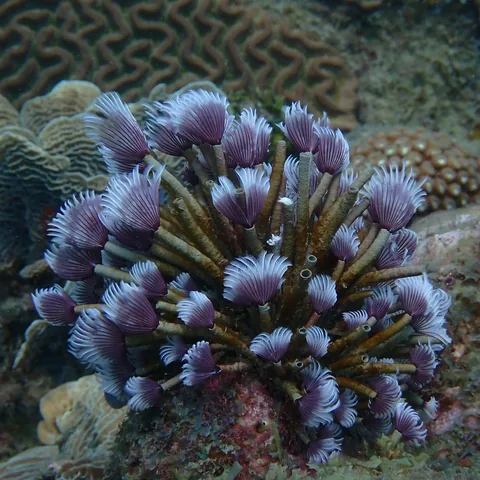
Social feather duster wormBispira brunneaFoto: Eric Crandall / iNaturalist · CC BY 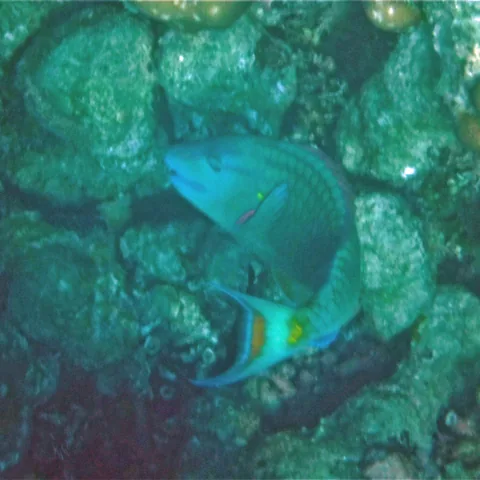
Stoplight parrotfishSparisoma virideFoto: Louis Imbeau / iNaturalist · CC BY
Hours, prices and conditions can change: confirm with the organizer or the venue before you go.
Sources
- Parques Nacionales Naturales: Resolución 0160 de 2020, Plan de Manejo del PNN Los Corales del Rosario y de San Bernardo ↗
- Parques Nacionales Naturales: Resolución 0273 de 2007, canales de navegación y sitios permitidos para buceo y amarre en el PNN Corales del Rosario y de San Bernardo ↗
- Parques Nacionales Naturales: proyecto de resolución que adopta la capacidad de carga de sitios del PNN Corales del Rosario y de San Bernardo (2023) ↗
- Parques Nacionales Naturales: concepto jurídico sobre pesca en las áreas protegidas, con el artículo 30 del Decreto 622 de 1977 ↗
- El Espectador: Parque Corales del Rosario y de San Bernardo 2026, lo que necesita saber antes de ir (mayo de 2026) ↗
- Occidente: llamado a ecoturismo responsable en Corales del Rosario y San Bernardo (marzo de 2026) ↗
- Parques Nacionales Naturales: ecoturismo en el PNN Corales del Rosario y de San Bernardo, aciertos y desaciertos (2024) ↗
- Ministerio de Ambiente: entre el 70 % y el 80 % de los arrecifes coralinos del país han presentado blanqueamiento (noviembre de 2023) ↗
- Mongabay Latam: la milagrosa supervivencia de los corales de Varadero en la bahía de Cartagena (julio de 2018) ↗
- Mongabay Latam: acróporas, la primera línea de corales que está desapareciendo en el Caribe colombiano (junio de 2026) ↗
- Mongabay Latam: torneos para capturar al pez león y controlar su invasión (noviembre de 2018) ↗
- La FM: Colombia convierte su lucha contra el pez león en un manjar ↗
- Castro Triana y Pereira Chaves: impacto de la actividad turística sobre los arrecifes coralinos del PNN Corales del Rosario y San Bernardo (Cuadernos de Investigación UNED, 2016) ↗
- Colombia Travel (ProColombia): buceo en Cartagena ↗
- Colombia Travel (ProColombia): Islas del Rosario y de San Bernardo ↗
Diving in Cartagena: reefs, shipwrecks and the story of the sea →