
Diving / Marine life and conservation
Lionfish: the reef invader
It reached Colombia in 2008, eats young reef fish and has no natural predators in the Caribbean. If you see one, don't touch it.
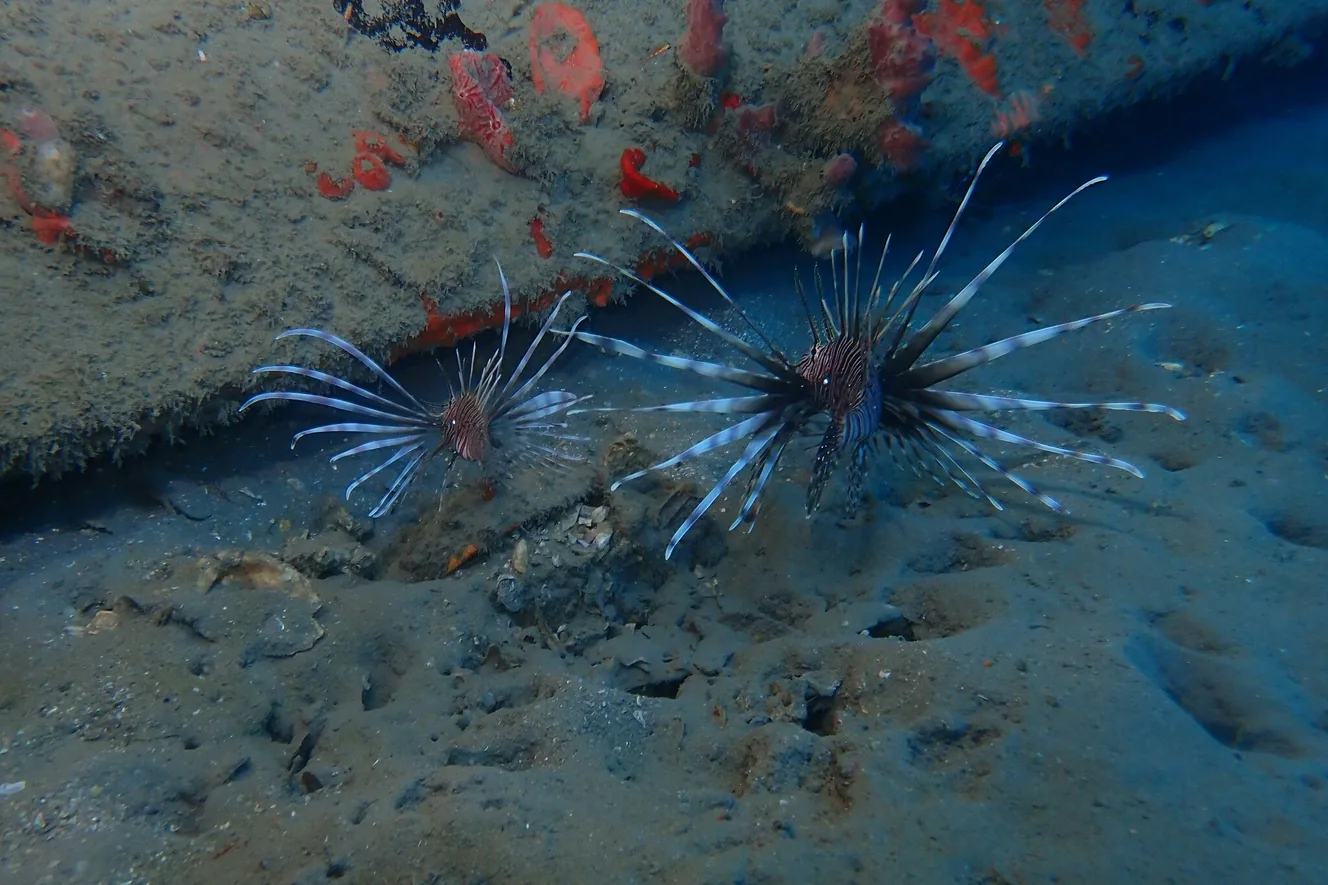
- Depth
- In Colombia it has been seen from less than one metre down to 70 metres; in San Bernardo, the park recorded it between 1 and 30 metres (Ministry of Environment)
- Where
- The whole Colombian Caribbean, including Corales del Rosario y de San Bernardo National Natural Park and Cartagena Bay
- Before you go
- Do not touch it or try to catch it: its spines are venomous. If one stings you, immerse the area in hot water, as the Ministry of Environment protocol advises, and seek medical attention. Point it out to your guide. At the table, ordering it helps control it.
It is easy to recognise: reddish and white stripes, fins spread like a fan and a deceptive calm. The lionfish (Pterois volitans) is native to the Indo-Pacific and is the first invasive marine fish to become widely established in the western Atlantic and the Caribbean, according to the management and control plan published by Colombia's Ministry of Environment in 2017. The document says there have been sightings in Florida since 1985 and that its introduction into the wild, through the release of aquarium specimens, was reported in 1995. From there it spread along the east coast of the United States and then through the Caribbean.
How it reached the Rosario Islands and San Bernardo
In Colombia, divers first saw it in late 2008 in Providencia and alerted Coralina, the archipelago's environmental authority. In May 2009, dive operators reported it in Granate Bay, inside Tayrona Park: the first record on the mainland coast. That same year, community members raised the alarm near Mangle Island, in San Bernardo, and in December the staff of Corales del Rosario y de San Bernardo Park confirmed it, with sightings between one and thirty metres deep. In 2010, Resolution 0207 of what was then the Ministry of Environment added it to the official list of invasive alien species.
Today, according to the plan, it is found along the entire Colombian Caribbean coast and its islands, on almost any kind of bottom: coral patches, mangrove roots, seagrass meadows, rocks, sand and sunken structures. In Colombia it has been seen from less than one metre deep down to 70 metres, in San Andrés. The dive guide ProColombia published in 2024 mentions it, under the name broadbarred firefish, among the things to see at Raya y Estrella, a site in San Bernardo.
Why it is a problem
The lionfish eats almost anything that fits in its mouth. The capture protocol included in the plan summarises studies showing that its diet is 78% fish and 14% crustaceans, and recalls that in the Bahamas recruits, the young fish that join a reef population, fell by 79% in just five weeks. In Corales del Rosario y de San Bernardo Park, staff found numerous juvenile damselfish, wrasses and gobies in their stomachs. It also competes with groupers and snappers, and eats the larvae of parrotfish and surgeonfish, herbivores that help keep algae off the coral.
It breeds fast. In the Atlantic it spawns every four days, which amounts to more than two million eggs a year, according to the same protocol. And in the Caribbean it has no natural predators, Mongabay noted in 2018. At the Oceanario de las Islas del Rosario, which has worked for years on breeding the goliath grouper, scientific director Jaime Rojas told El Espectador in 2017 that he wanted the released groupers to learn to recognise and eat it. The experts quoted by El Heraldo that same year considered eradication almost impossible. The aim is control.
Catch it and eat it
Capture began early. According to the plan, since Resolution 132 of 2010 National Parks has regularly organised capture days with the support of dive centres, and tournaments with the communities around Corales del Rosario y de San Bernardo Park. In December 2020, when Cartagena's dive centres launched Asobuceo, they held lionfish hunts, El Universal reported. In 2017, El Heraldo reported on a project backed by the city government in which 40 at-risk young people from Isla Fuerte, guided by the island's fishermen's association, would go out to catch it and sell its meat.
The other half of control is on the plate. The Ministry of Environment promotes catching and eating it; according to Mongabay, it published capture techniques and recipes. An EFE report said that in the Rosario Islands the Diving Planet Foundation organised mass captures with local residents, and that a Cartagena restaurant had created six dishes with its meat, which its chef compared to sole. The belief that it cannot be eaten because of the venom is a myth, according to Mongabay: the venom is in the spines, not the fillet.
If you see one underwater
Do not touch it. The lionfish stores its venom in the spines of its fins and injects it when they are pressed. The protocol describes extreme pain, swelling, nausea, dizziness, difficulty breathing and, in some cases, necrosis of the area; no human death from its venom is known. Because the venom is a protein that breaks down with heat, the protocol advises immersing the affected part in hot water for minutes to hours. Seek medical attention as well.
Do not hunt it on your own either. In protected areas, the protocol limits removal to National Parks staff and contractors, certified divers, researchers and authorised fishermen accompanied by park personnel, with a plan agreed for each outing. If coral or any other resource is damaged during capture, the penalties of Law 1333 of 2009 apply. If you are diving, the useful thing is to point it out to your guide. And if you see it on a restaurant menu, ordering it helps too.
El invasor en el Caribe colombiano (2)
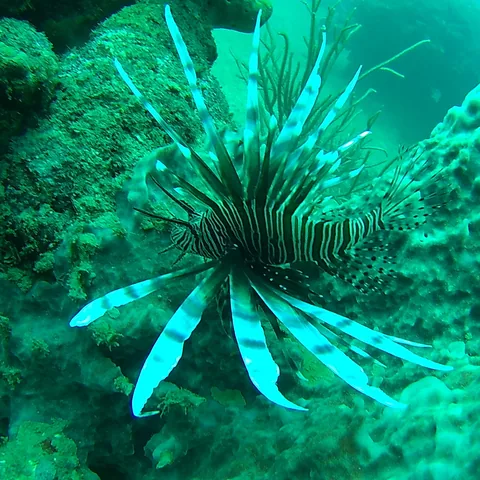
Lionfish in the Colombian CaribbeanPterois volitansFoto: Naturalist Tours / iNaturalist · CC0 · Santa Marta, foto ilustrativa 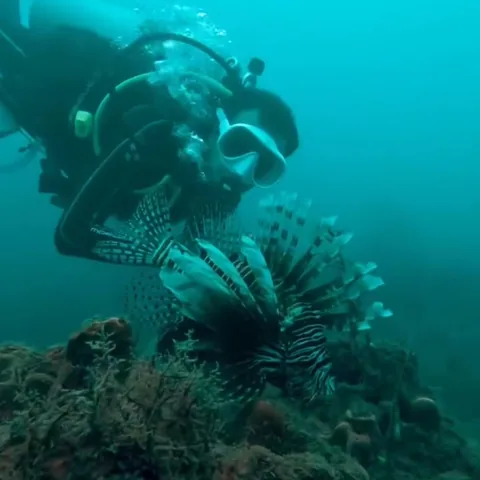
Diver next to a lionfishPterois volitansFoto: Michael Cantillo / iNaturalist · CC BY · Santa Marta, foto ilustrativa
Hours, prices and conditions can change: confirm with the organizer or the venue before you go.
Sources
- Ministerio de Ambiente: Plan para el manejo y control del pez león, Pterois volitans, en el Caribe colombiano (2017), con el protocolo de captura, extracción y disposición final ↗
- Mongabay: Torneos de captura del pez león en Colombia (2018) ↗
- El Espectador: El último plan para acabar con el pez león (2017) ↗
- El Heraldo: Pandilleros ahora van tras el pez león en Cartagena (2017) ↗
- El Universal: Las empresas de buceo en Cartagena lanzan Asobuceo (2020) ↗
- La FM (EFE): Colombia convierte su lucha contra el voraz pez león en un manjar exquisito ↗
- ProColombia: Guía de buceo de Colombia (2024) ↗
Diving in Cartagena: reefs, shipwrecks and the story of the sea →