
Diving / Wrecks where diving is not allowed
Ships sunk in 1741: Bocachica and the Manzanillo passage
To block the English fleet, Blas de Lezo sank his own warships. Four of them are still on the floor of the bay.
- Depth
- Between about 15 and 30 metres, according to the Dimar multibeam survey published in 2022: Conquistador 15.6 m, Dragón 20 m, África 23.3 m and San Carlos 29.7 m.
- Where
- Cartagena Bay: the colonial channel of Bocachica (África and San Carlos) and the channel between Manzanillo island and Castillogrande, at the entrance to the inner bay (Conquistador and Dragón).
- Getting there
- This is not a recreational dive site. The hulls lie in the bay's shipping channels, with almost zero visibility because of sediment from the Canal del Dique. The Manzanillo passage marks the edge of the inner bay, where the Harbour Master bans water sports (Resolution 0089 of 2017). And because of their age and history, the remains fall under Law 1675 of 2013: they may only be explored or intervened in with authorisation from the Ministry of Culture. The story is best followed on land, at the Bocachica forts.
- Before you go
- Do not book dives in the bay that promise to show you Lezo's warships: they are not authorised recreational dive sites. If you dive elsewhere and come across old remains, do not touch or remove them; the law requires you to notify the Harbour Master or the nearest civil authority within 24 hours of returning to land.
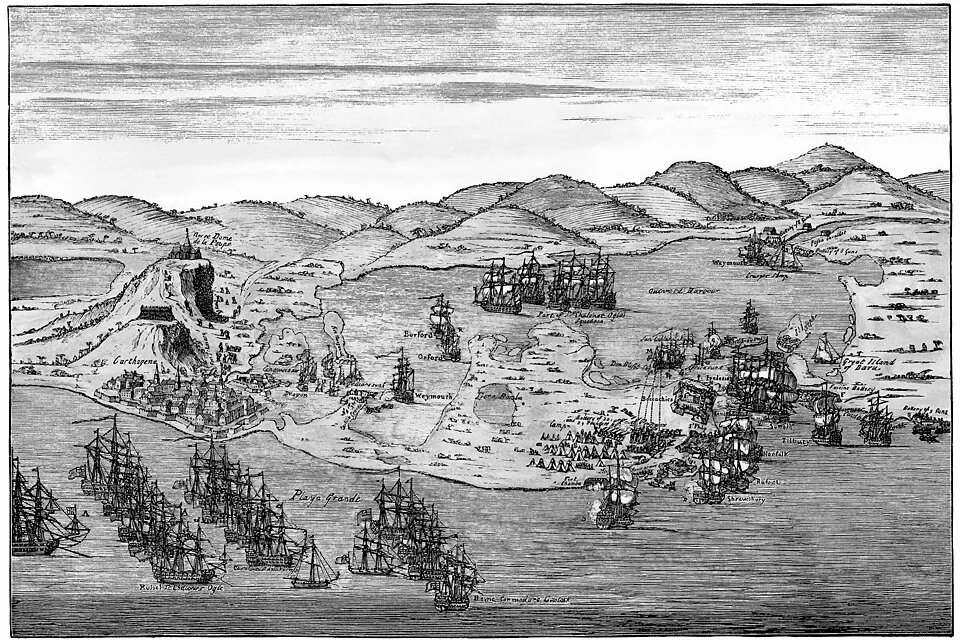
In the spring of 1741 the floor of Cartagena Bay filled with Spanish ships sunk on purpose. The city was resisting an English siege that began on 13 March and ended on 20 May with the attackers' withdrawal. To stop the enemy fleet, Admiral Blas de Lezo used his own warships as plugs. Almost three centuries later, Dimar found them again.
A defence made of hulls
Lezo's fleet had six large warships: Galicia, San Felipe, Conquistador, Dragón, África and San Carlos, plus smaller vessels. That is how an article published in 2022 in the International Hydrographic Review by Dimar researchers sums it up, drawing on Lezo's own diary. First the ships were stationed in the Bocachica channel, the southern and deeper entrance to the bay, the only one large ships could use. On 5 April, after several engagements, the San Felipe and the África were set on fire and sunk in the colonial channel, and their crews returned to the city.
When the English managed to enter the bay, the defence fell back. On 9 April, at a meeting in the house of Viceroy Sebastián de Eslava, it was agreed to sink every available ship in a straight line between Castillo Grande and Manzanillo island, to close the access to the inner bay. That was the fate of the Conquistador, the Dragón and other smaller ships. According to the same study, the English later towed the Conquistador to reopen the passage, which is why it lies parallel to the channel rather than across it like the others.
What Dimar found
The submerged cultural heritage team at Dimar's Caribbean Oceanographic and Hydrographic Research Centre compared period charts and chronicles with a multibeam echosounder survey, side-scan sonar and diver inspections. It found five anomalies on the seabed, four of which match the warships: the Conquistador and the Dragón in the military channel leading into the inner bay, and the África and the San Carlos in the colonial channel of Bocachica. The hulls lie between 15.6 and 29.7 metres deep and measure between 30 and 40 metres long.
On the Conquistador, divers photographed hull timber and river stones used as ballast. On the Dragón, the sonar revealed at least ten cannons. At Bocachica not a single photo could be taken: sediment carried by the Canal del Dique covers those remains more heavily and leaves visibility close to zero. Even so, the authors classify all four contexts as intact and conclude that Colombia still has to decide how to conserve them and make them known.
Remains that surface with the dredgers
The bay holds more. In 2014, before the Bocachica and Manzanillo channels were dredged, the State required archaeological studies. Sonar and diving revealed, off the Casa de Huéspedes Ilustres and near the fort of San Juan de Manzanillo, a group of more than a hundred pieces of timber and a cannon, which the researchers tentatively attributed to an eighteenth-century vessel sunk by Lezo. The work was led by archaeologist Carlos del Cairo, of the Terra Firme Foundation and Externado University, with ICANH authorisation, Navy divers and specialists from five countries, El Universal reported. With visibility down to ten centimetres, they documented every piece and reburied it under sand and geotextile, to preserve it without oxygen.
Why they are not dived
The reasons add up. The hulls lie in channels used by ships entering and leaving the bay, and the Bocachica channel is now dredged to more than 20 metres. Visibility is almost nil. Cartagena's Harbour Master bans water sports north of the line between Manzanillo island and the Club Naval, that is, across the whole inner bay. And Law 1675 of 2013 states that the remains of wrecks more than a hundred years old with historical value belong to the Nation: exploring or intervening in them without authorisation from the Ministry is a crime. The way to approach this story is on land: at Bocachica, the fort of San Fernando and the battery of San José still stand, guarding the channel where the África and the San Carlos lie.
La batalla de 1741 en grabados y pinturas (1)
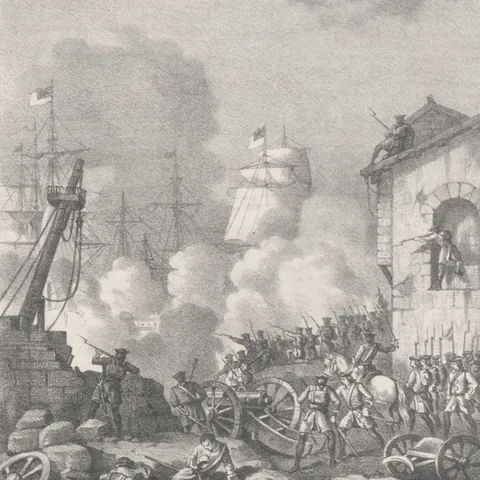
English attack on Cartagena, 1741Pintura: Josep Serra i Porsón / Wikimedia Commons · dominio público
Hours, prices and conditions can change: confirm with the organizer or the venue before you go.
Sources
- Quintana-Saavedra, Andrade-Amaya, Guzmán-Martínez, Torres-Parra y Prada-Rueda: Characterization of four shipwrecks from 1741 in Cartagena Bay, International Hydrographic Review (mayo 2022) ↗
- El Universal: Detrás del hallazgo de patrimonio subacuático (2015) ↗
- Capitanía de Puerto de Cartagena (Dimar): Resolución 0089 de 2017, actividades de recreación y deportes náuticos ↗
- Ley 1675 de 2013 (normograma JEP) ↗
Diving in Cartagena: reefs, shipwrecks and the story of the sea →