
Diving / Cartagena and the sea
Cartagena, port of the fleets
Galleons, enslaved people, coral stone and containers: four centuries of history that came and went through the same bay.
- Where
- Cartagena Bay, with its Bocachica entrance and the mouth of the Canal del Dique
- Before you go
- This is a history entry, not a dive site. Shipwreck remains in the bay are submerged cultural heritage, protected by Law 1675 of 2013: do not touch or remove anything. To dive near Cartagena, go with a certified dive centre.
To understand the sea at Cartagena, you have to start with the bay. The city was founded on its shore and grew up facing the water. Its street plan follows the line of the coast rather than the Spanish grid, and for years its main square, today's Plaza de la Aduana, was called Plaza del Mar, the Sea Square. The book Cartagena de Indias en el siglo XVII, published by Colombia's central bank, the Banco de la República, in 2007 with the papers from a symposium on the city's history, recalls as much.
The city's reliance on the sea also had a reason inland. The countryside around Cartagena had few Indigenous inhabitants: in 1560 the province's largest encomienda, Tubará, counted just 365 able-bodied Indians, according to the same book. What the city needed, and what made it rich, arrived by ship.
The century of the galleons
From 1564, Spain organised its trade with the Americas in armed convoys. One fleet sailed to Veracruz, in New Spain. The other, the Tierra Firme galleons, entered Cartagena Bay to load South American goods, above all silver from Potosí, and went on to Portobelo, on the coast of Panama. There it waited for Peruvian silver, which came up the Pacific to the isthmus and crossed it by mule. The two fleets then met in Havana for the voyage back to Spain.
The authors gathered by the Banco de la República call the 17th century the century of the Tierra Firme fleet. While the galleons were in the bay, their timbers had to be repaired, and their crews fed, clothed, entertained and given Mass. When they left, the city emptied. The physician Juan Méndez Nieto wrote in Cartagena in 1607 that almost every building stood empty.
The sea also brought the worst of that era. Hundreds of thousands of enslaved Africans entered through the bay and were held in the courtyards of merchants' houses before being sold. For most of the 17th century, that traffic was the main source of revenue for Cartagena's royal treasury. And the sea brought the coral stone that, early in that century, allowed the city to replace houses built of plant materials with lasting buildings.
The system left ships on the seabed. The best known is the galleon San José, of the Tierra Firme fleet, which sank on 8 June 1708 in the battle of Barú, facing an English squadron; it has its own entry in this section. A study released by Colombia's maritime authority, Dimar, in 2024, based on survivors' testimony, argues that it did not explode: it would have gone down because of a botched repair after an accident on the voyage between Cartagena and Portobelo. It lies more than 600 metres down.
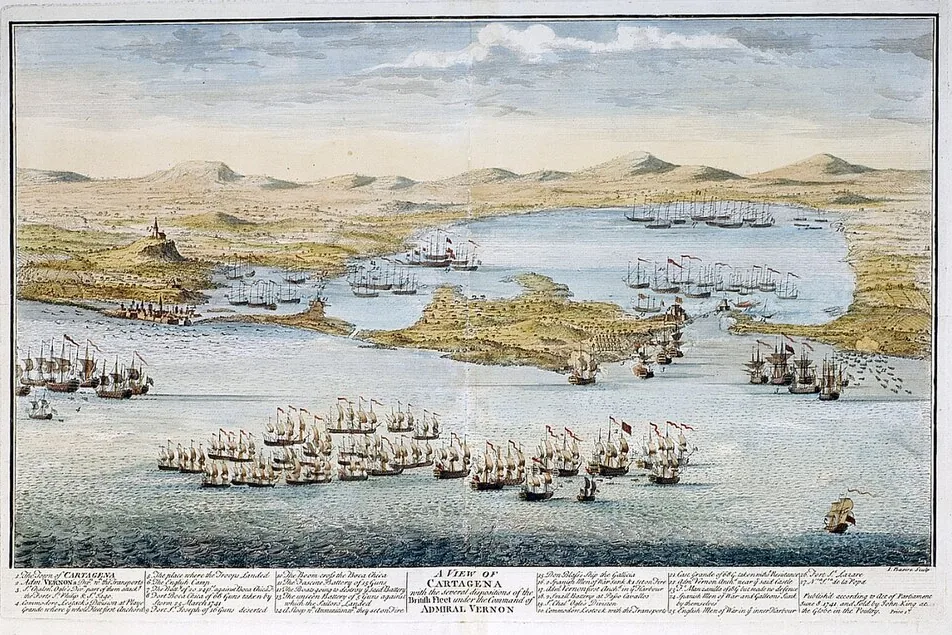
In the 18th century the galleons gradually lost their purpose. In 1739, in the middle of the war with Great Britain, Admiral Edward Vernon blockaded Portobelo. The Bourbon reforms slowly replaced the convoys with ships sailing alone, the so-called register ships, and the Free Trade Regulation of 1778 ended the monopoly on shipping to the Americas.
A canal to the river
Cartagena had a problem: the Magdalena River, the great route into the interior, was far away, and the road overland became impassable in the rainy season. In 1650, Governor Pedro Zapata de Mendoza, advised by the engineer Juan de Somovilla y Tejada, had a canal dug between the bay and the river. Some two thousand men worked with axes, picks and shovels for six months. It is the Canal del Dique.
The canal silted up and was reopened several times. It was dug again from 1845, and in the 20th century it was straightened to make it easier to navigate: between 1950 and 1952 its bends went from 113 to 93, and between 1981 and 1984 from 93 to 50. Each cut increased the amount of Magdalena water reaching the bay and, with it, the sediment. According to Colombia's National Parks service, quoted by Mongabay in 2018, that sediment wiped out 80% of the corals of the Rosario and San Bernardo islands.
Today the canal is 115.5 kilometres long, according to the National Infrastructure Agency. A project plans locks and gates at Calamar and Puerto Badel to control the flow and stop sediment from entering the bays of Cartagena and Barbacoas. In August 2026, the environmental licensing authority, ANLA, unblocked the process, although it ordered updated studies on water, sediment and biodiversity, Forbes Colombia reported.
The port today
Large ships still enter through Bocachica, the bay's only navigable mouth. In 2014 a contract was awarded to deepen its access channel from 15.5 to 20.5 metres and widen it from 84 to 150, so it could take ships carrying up to 12,000 containers, Mundo Marítimo reported at the time. In 2025, Grupo Puerto de Cartagena handled four million containers in a single year for the first time, with more than 3,500 container ships served at its terminals, according to Portafolio.
Anyone heading out to dive from the Muelle La Bodeguita crosses that same bay. Along the way come the anchored container ships, the Bocachica forts and, depending on the day, the murky water carried by the Dique. It is the route the galleons sailed, with different ships.
Hours, prices and conditions can change: confirm with the organizer or the venue before you go.
Sources
- Banco de la República: Cartagena de Indias en el siglo XVII (Meisel y Calvo, eds., 2007) ↗
- Wikipedia (inglés): Spanish treasure fleet ↗
- Wikipedia: Flota de Indias ↗
- Dimar: investigación refuta la versión del hundimiento del galeón San José por una explosión (octubre 2024) ↗
- Wikipedia: Canal del Dique ↗
- Agencia Nacional de Infraestructura: preguntas y respuestas del Canal del Dique ↗
- Forbes Colombia: ANLA despeja el camino ambiental para reactivar el Canal del Dique (agosto 2026) ↗
- Mongabay Latam: corales de Cartagena y sedimentos del Canal del Dique (julio 2018) ↗
- Mundo Marítimo: Jan de Nul se adjudicó obras del canal de acceso a la bahía de Cartagena (septiembre 2014) ↗
- Portafolio: Grupo Puerto de Cartagena moviliza cuatro millones de contenedores (diciembre 2025) ↗
- Ministerio de Cultura / ICANH: ABC del Galeón San José (Ley 1675 de 2013) ↗
Diving in Cartagena: reefs, shipwrecks and the story of the sea →