
Diving / Cartagena and the sea
The bay's two mouths and what was left on the seabed
A stone wall underwater since the 18th century and ships sunk on purpose in 1741: Cartagena's defences are also beneath the sea.
- Where
- Entrances to Cartagena Bay: Bocagrande (between Bocagrande and Tierra Bomba) and Bocachica (between Tierra Bomba and Barú)
- Before you go
- The breakwater and the Bocachica wreck are archaeological sites, not recreational dive spots; submerged cultural heritage is protected by Law 1675 of 2013 and must not be touched or removed. Bocachica is also the shipping channel for cargo vessels. Salmedina is visited only with a certified dive centre and is for advanced divers because of the currents.
From the beach at Bocagrande, the island of Tierra Bomba looks a few strokes away. There are some two kilometres of water between them, and yet no large ship enters the bay that way. They all go round and pass through Bocachica, the narrow channel between Tierra Bomba and Barú. The reason cannot be seen from the shore: it lies underwater, and it is a stone wall that has been on the seabed for nearly two and a half centuries.
A mouth that opened and closed
Bocagrande was never a stable entrance. Sand arriving from the mouth of the Magdalena has kept reshaping it, explain Carlos Andrade, Richard Guzmán and Diana Quintana, of the submerged cultural heritage group at Dimar, Colombia's maritime authority, in a 2022 article in the journal of the Colombian Academy of Exact Sciences. In 1586 it was open: the account of Francis Drake's attack says he entered and landed there.
Half a century later it closed. According to the same research, quoted by El Universal in 2023, in 1640 ships of a Portuguese fleet ran aground in the entrance, and a strip of sand built up around their hulls and blocked the channel. The maps the Baron de Pointis had drawn for his 1697 attack show Bocagrande and Tierra Bomba joined by land. The maps prepared by British intelligence for Edward Vernon in 1741 already show a small channel, too narrow for the attacking fleet.
After the British withdrew, that channel widened fast. By the time the engineers arrived to repair the defences, the sand had almost completely vanished and Bocagrande was open again.
The wall you cannot see
The answer was an underwater breakwater. A royal order of 15 October 1764 entrusted the project to the engineer Antonio de Arévalo, who signed the plan in June 1769. The work was carried out between 1771 and 1778, according to the Academy article; El Universal gives 1768 to 1778. The method was simple and laborious: four parallel lines of piles driven into the seabed, on either side of the sandbar that still remained, formed boxes that were then filled with small stones, then larger stones and, on top, very large rocks.
The researchers reconstructed its course using multibeam bathymetry from Dimar's Hydrographic Service and old plans. They calculate that the wall starts on the Bocagrande shore with a 622-metre stretch running southwest, now buried under the beaches, and continues in a 1,914-metre curve towards the northern tip of Tierra Bomba, which is still submerged. In all, 2,536 metres.
The breakwater did something nobody had planned. It worked as a sand trap: currents piled sand against the wall and the shoreline advanced. Some 44.4 hectares of Bocagrande, a good part of the district of hotels and tower blocks, is land gained from the sea thanks to that military work.
Bocachica: the ships sunk on purpose
With Bocagrande closed, the whole defence was concentrated at Bocachica. In 1741, facing Vernon's fleet, Blas de Lezo had six ships, and he sank vessels in the bay's narrow entrances to block the British, National Geographic recalls.
In 2014, ahead of a dredging project in the channel, ICANH ordered a routine survey. Sonar and a magnetometer picked up anomalies on the seabed, and divers found, at a depth of about five metres, the remains of an early 18th-century Spanish warship. It may be the San Felipe, one of the largest ships Lezo sank, although the archaeologists say more analysis is needed to confirm it; there are signs that it burned before going down. The excavation was led by the Fundación Terra Firme, with the archaeologist Carlos del Cairo.
An article published by the Universidad de los Andes, written by Carla Riera Andreu of the Universidad Externado, details what was found: a fragment of keel, iron nails, ballast stones, ceramics and lead sheathing. The plan was to take only the small inorganic objects to the San Fernando fort and leave the wood where it was, reburied under sediment and shade cloth.
Beyond the mouths: Salmedina and Varadero
Before reaching the mouths, ships had to steer clear of the shoals. On the Salmedina shoal, about five nautical miles from the city, the Colombian Institute of Anthropology and History (ICANH) counts several identified wrecks; the first investigation, at the site known as Salmedina 1, began in the 1990s, and at Salmedina II there is a cannon and an anchor. Some dive centres take certified divers there: according to Colombia Travel, currents are strong and the level is advanced.
Between Tierra Bomba and Barú, next to the entrance, there is also a reef few people expected. Varadero covers about 102 hectares a few metres deep, and in 2018 it still had 90% of its coral cover in good condition, according to Mongabay. It was identified by the researchers Valeria Pizarro and Mateo Victoria while they were relocating colonies for the studies for a second access channel for deep-draught ships. That channel, they warned, could destroy 25% of the reef directly and affect another 50%. The defence of Cartagena's sea, it seems, is still being argued underwater.
Bocachica hoy (2)
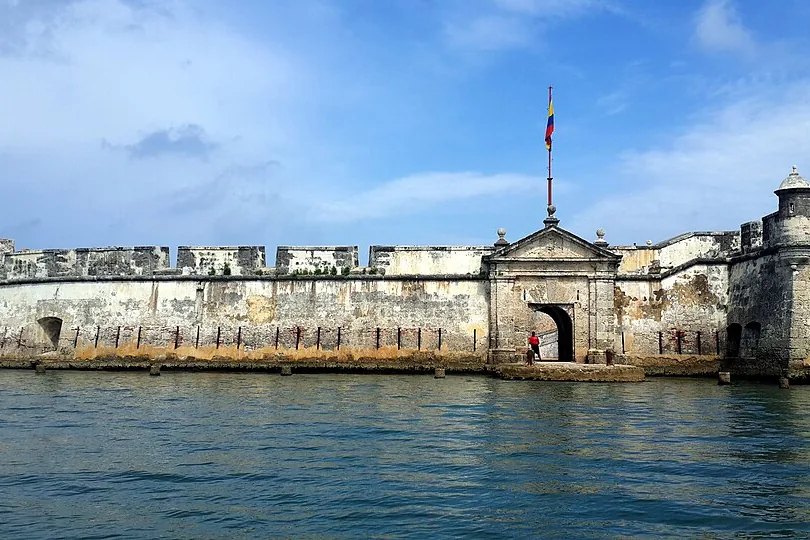
San Fernando wall seen from the seaFoto: Samael Alejandro Zapata Ibarra / Wikimedia Commons · CC BY-SA 3.0 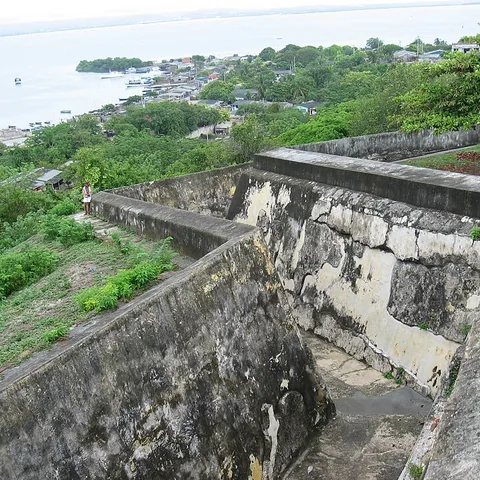
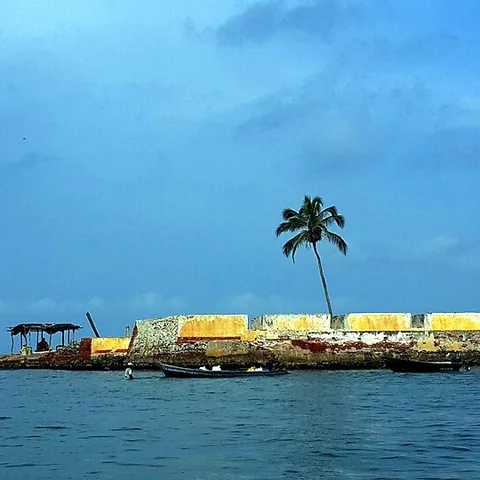
Ángel batteryFoto: La guarda del angel / Wikimedia Commons · CC BY-SA 4.0
Hours, prices and conditions can change: confirm with the organizer or the venue before you go.
Sources
- Revista de la Academia Colombiana de Ciencias Exactas: avance de la línea de costa de Bocagrande y la escollera (Andrade-Amaya, Guzmán-Martínez y Quintana-Saavedra, 2022) ↗
- El Universal: una muralla submarina mantiene a flote a Bocagrande (junio 2023) ↗
- El Universal: los objetos arqueológicos que se esconden bajo el mar de Cartagena (agosto 2024) ↗
- National Geographic: shipwreck from 1741 battle found off Cartagena (noviembre 2015) ↗
- Universidad de los Andes (OPCA): proteger y conservar el patrimonio cultural sumergido, el pecio de Bocachica (Carla Riera Andreu) ↗
- Colombia Travel (ProColombia): buceo en Cartagena ↗
- Mongabay Latam: corales de Cartagena sobreviven a la contaminación, arrecife de Varadero (julio 2018) ↗
- Cartagena Caribe: fortificación de Cartagena (escollera entre Punta Icacos y Tierrabomba) ↗
- Ministerio de Cultura / ICANH: ABC del Galeón San José (Ley 1675 de 2013) ↗
Diving in Cartagena: reefs, shipwrecks and the story of the sea →