
Diving / Cartagena and the sea
The sea below: reefs, islanders and divers
Islands that were once reefs, a park created in 1977 and villages living on the water: the story of the Rosario sea.
- Where
- Corales del Rosario y de San Bernardo National Natural Park, southwest of Cartagena Bay
- Before you go
- Dive with a certified centre, within your level, and pay the park entry fee. Do not touch or stand on the coral and do not buy souvenirs made from it. If you visit Orika or Santa Cruz del Islote, remember they are villages where people live, not stage sets: ask before entering houses or yards.
The first surprise about the Rosario Islands is how low they are. There are no hills or cliffs, just a rim of land and mangrove above the water. There is a reason. In 1987, Serge Leble and his co-author published a study of the archipelago in the scientific bulletin of the Oceanographic and Hydrographic Research Centre (CIOH), part of Colombia's maritime authority, Dimar. According to that work, the islands are ancient reefs that now sit two to three metres above sea level, formed during the last marine transgression, the last time the sea rose over the shelf.
Because those terraces of fossil coral appear at a constant height, the authors concluded that tectonics, very active on the shelf, had not moved them. Around them, the living reef kept growing. Leble described the whole as a reef complex: fringing reefs, barriers, small atolls, islands, mangroves and lagoons sharing the same sedimentary area. Colombia's National Parks service now estimates about 420 square kilometres of coral platform, the largest off the mainland Colombian Caribbean coast.
The 1987 study already pointed to an awkward neighbour: sediment from the Canal del Dique. Part of that load travels in suspension to the archipelago's shoals and settles, above all, in the trench that separates Isla Rosario, Isla Grande and Isla Arena.
A park for the coral
On 6 June 1977, Resolution 165 approved the agreement of Inderena, the former natural resources institute, that created the Los Corales del Rosario National Natural Park: 17,800 hectares within Cartagena's jurisdiction. The reasons were set out in general terms: to conserve the flora, fauna, scenic beauty, geomorphological features and historical and cultural sites, for scientific, educational, recreational or aesthetic purposes. In 1988 the boundaries were redrawn at 19,506 hectares, and on 20 December 1996 Resolution 1425 brought the park to about 120,000 hectares, added the San Bernardo archipelago and gave it its current name.
Protecting the coral has not been easy. In 2002, El Tiempo reported that the main concern of the land agency Incora and the Inspector General's Office was the destruction of the underwater park by construction that had used reef material taken from the seabed to enlarge some islands. In 2013, the same newspaper reported that coral cover mortality in Rosario had reached 70% over three decades, and that sediment forced divers to go down in murky water.
The people who live on the water
Before the tourists and the divers, there were people on the islands. In 1851, the year slavery was abolished in New Granada, five freed slaves bought seven caballerías of mangrove land on Barú and recorded that the purchase was collective, for all the families. That is the origin of the community of Orika, on Isla Grande, whose community council now represents some 300 families, according to a column by Vivian Newman, of the research centre Dejusticia, published in El Espectador in 2023. In 2012, the Constitutional Court recognised for the first time the collective land title of a Black community on the islands of the Colombian Caribbean.
The same column says that fishing, one of the island's livelihoods along with coconuts, declined because of the use of dynamite and the catching of fish that were too small. Many sold what they had and ended up as caretakers and cooks for the new owners. Today the community runs eco-lodges, has planted thousands of red mangrove seedlings and looks after what it calls its maritorio, its marine territory.
Further south, in San Bernardo, lies Santa Cruz del Islote. According to Radio Nacional, its origins go back some 200 years, when fishermen who spent the night there noticed there were no mosquitoes and decided to stay; other sources place it at the end of the 19th century. They gradually gained ground with fill made of stone, shells and rubble. On little more than a hectare, about 816 people live in some 160 houses, collecting rainwater and living from fishing and tourism.
The divers arrive
We found no reliable source saying when recreational diving began in Cartagena or which was its first school. What is documented is how it has been organised. The park arranges underwater visits along trails, and in December 2020 the city's dive centres created Asobuceo, backed by Dimar, the Harbour Master's Office, National Parks and ProColombia. At its launch they installed mooring buoys to protect the reef and went out to hunt lionfish, an invasive species.
As the natural reef became overcrowded, alternatives were sought. Divers from the Naval Base sank the boats Tolú and Atlas off Barú, and in November 2015 the former ship ARC Quindío was sunk there. The idea, the biologist Juan Carlos Gutiérrez told El Heraldo at the time, was to stop overloading the natural reef with visitors and create an artificial one as a buffer. A study published in 2016 in Cuadernos de Investigación UNED shows why it was needed: 74% of the divers observed on the Rosario trails touched the bottom at least once, especially the less experienced.
That is the sea below: islands made of ancient coral, a living reef holding out against sediment and heat, and communities that arrived before anyone else. Diving here, with a certified centre and without touching anything, means entering that story.
Habitantes del arrecife (2)
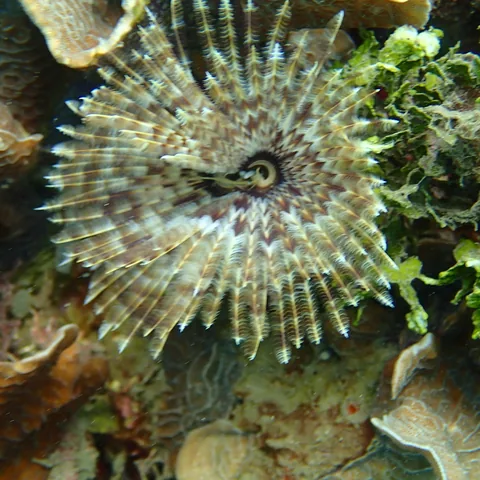
Magnificent feather dusterSabellastarte magnificaFoto: Eric Crandall / iNaturalist · CC BY 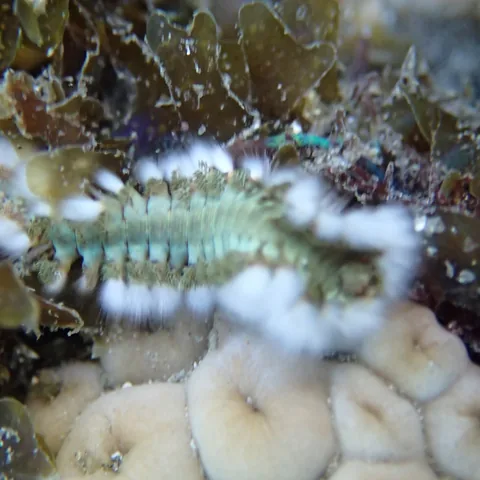
Bearded firewormHermodice carunculataFoto: Eric Crandall / iNaturalist · CC BY
Hours, prices and conditions can change: confirm with the organizer or the venue before you go.
Sources
- Boletín Científico CIOH (Dimar): El archipiélago de las Islas del Rosario, estudio morfológico, hidrodinámico y sedimentológico (Leble y Cuignon, 1987) ↗
- Parques Nacionales Naturales: PNN Los Corales del Rosario y de San Bernardo ↗
- Parques Nacionales Naturales: concepto técnico de precisión del límite del PNN Corales del Rosario y de San Bernardo (2016), con las resoluciones de 1977, 1986, 1988 y 1996 ↗
- El Tiempo: Fin de letargo en Islas del Rosario (septiembre 2002) ↗
- El Tiempo: El ocaso de los arrecifes de coral en el Caribe (diciembre 2013) ↗
- El Espectador: Una isla con corazón, la historia del consejo comunitario de Orika (Vivian Newman, junio 2023) ↗
- Radio Nacional de Colombia: Santa Cruz del Islote, la isla más poblada (junio 2023) ↗
- El Universal: las empresas de buceo en Cartagena lanzan Asobuceo (diciembre 2020) ↗
- El Heraldo: así hundieron un buque para transformarlo en un arrecife (noviembre 2015) ↗
- Cuadernos de Investigación UNED: impacto del turismo sobre los arrecifes del PNN Corales del Rosario y San Bernardo (junio 2016) ↗
Diving in Cartagena: reefs, shipwrecks and the story of the sea →